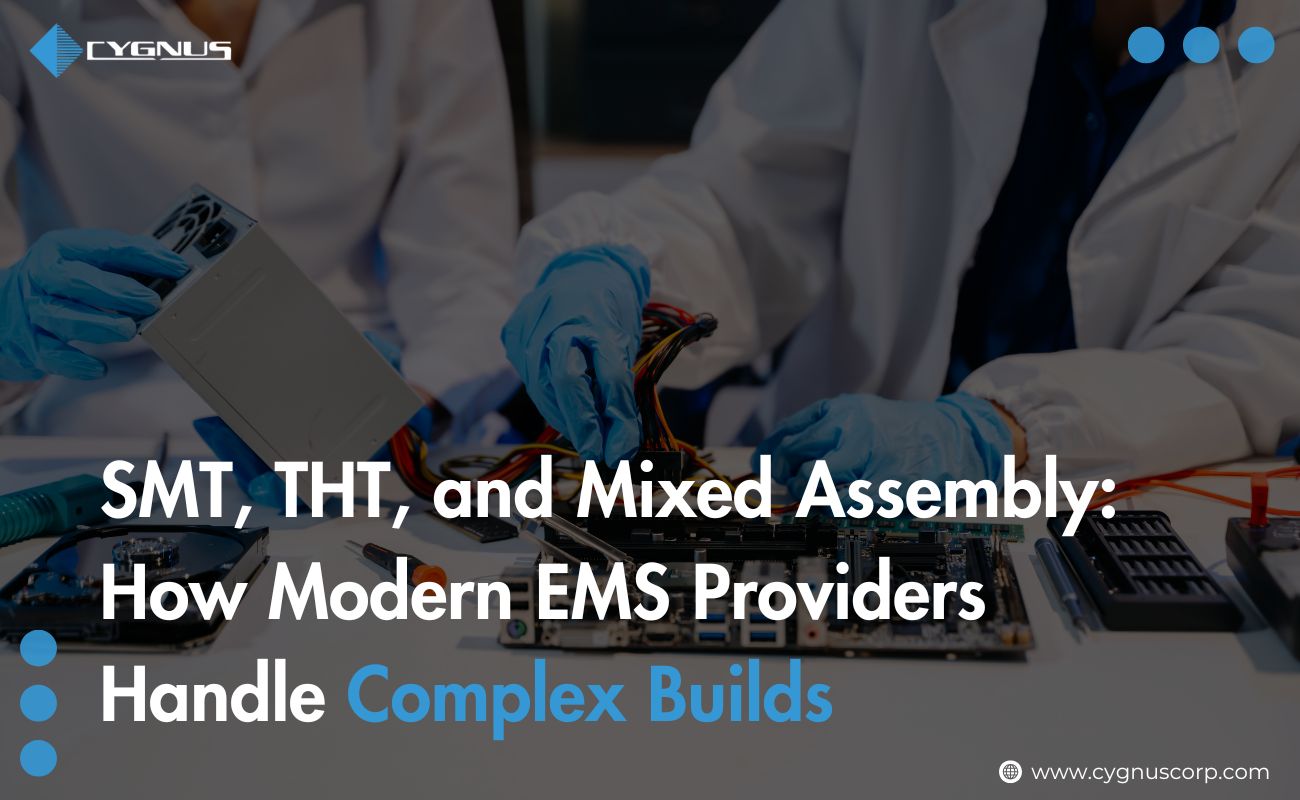
Electronics manufacturing is no longer about choosing a single assembly method and scaling it endlessly. Today’s products are smaller, denser, and more specialized, often combining high-speed processors, power components, and mechanical connectors on the same board. This is where SMT THT and mixed assembly become essential.
For companies relying on PCB assembly services in Canada, understanding how modern electronics manufacturing services (EMS) manage these assembly types is critical to building reliable, scalable, and cost-effective products.
Why Assembly Method Matters More Than Ever?
Modern electronics are expected to do more, consume less power, and survive harsher environments. A single PCB may need compact surface-mount components alongside heavy connectors or high-current parts. This creates complex PCB assembly requirements that can’t be solved with a one-size-fits-all approach.
Advanced EMS providers don’t just assemble boards. They design assembly strategies that balance performance, durability, and manufacturability from day one.
Also Read: Why Flux Is Critical in SMT Reflow Processes
What Is SMT Assembly and Where It Excels?
Surface Mount Technology (SMT) is the backbone of modern electronics manufacturing. Components are placed directly onto the surface of the PCB, allowing for:
- Higher component density
- Faster automated assembly
- Lower production costs at scale
- Smaller, lighter product designs
SMT is ideal for consumer electronics, IoT devices, medical electronics, and communication systems where space and precision matter. Most electronics manufacturing services (EMS) rely heavily on SMT for speed and consistency, especially in automated production environments.
What Is THT Assembly and Why It Still Matters?
Through-Hole Technology (THT) involves inserting component leads through holes in the PCB and soldering them in place. While it may seem traditional, THT remains critical for:
- Components requiring strong mechanical support
- High-power or high-current applications
- Connectors, transformers, and large capacitors
In industrial and power electronics, THT provides durability that SMT alone cannot. This is why modern EMS providers continue to invest in both automated and selective THT processes.
Mixed Assembly: The Reality of Modern PCB Design
Most real-world products require mixed SMT and THT PCB assembly. A single board may include fine-pitch SMT components alongside through-hole connectors and power modules.
This mixed assembly approach is common in:
- Medical devices
- Industrial control systems
- Automotive and transportation electronics
- Specialized IoT hardware
Handling mixed builds correctly is one of the clearest indicators of an EMS provider’s technical maturity.
Why Complex PCB Assemblies Are Challenging?
Complexity in PCB assembly doesn’t come from component count alone. It comes from how those components interact during manufacturing.
Common challenges include:
- Managing different soldering processes on one board
- Preventing thermal stress during reflow and wave soldering
- Avoiding component shadowing and solder defects
- Maintaining consistent quality across low and mid-volume runs
This is why complex electronics assembly services demand both advanced equipment and experienced process engineers.
How Modern EMS Providers Handle Complex Builds?
Advanced EMS providers approach complex builds long before the first board is assembled.
They focus on:
- Design for Manufacturing (DFM) and Design for Assembly (DFA) reviews
- Optimized line sequencing for SMT and THT processes
- Selective soldering to protect sensitive SMT components
- Skilled manual assembly where automation isn’t viable
At Cygnus Electronics, mixed-technology builds are planned as systems, not steps. Each process is aligned to reduce rework, improve yield, and maintain long-term reliability.
Quality Control in Mixed Assembly Environments:
Quality assurance becomes even more critical when multiple assembly methods are involved. Modern PCB assembly services in Canada rely on layered inspection and testing strategies, including:
- Automated Optical Inspection (AOI)
- X-ray inspection for hidden joints
- In-circuit and functional testing
- Full traceability and process validation
This approach ensures that complex assemblies perform reliably in real-world conditions, not just on the production line.
Choosing the Right Assembly Method for Your Product:
Selecting between SMT, THT, or mixed assembly depends on more than design preference.
Key factors include:
- Mechanical and environmental stress requirements
- Production volume and scalability
- Regulatory and reliability standards
- Long-term maintenance and serviceability
For startups and OEMs, working with an EMS partner experienced in low volume PCB assembly Canada can significantly reduce early-stage risk while keeping future scale in mind.
Why EMS Expertise Reduces Cost and Risk?
Assembly mistakes are expensive. Redesigns, delays, and field failures cost far more than proper planning.
Experienced EMS partners:
- Catch design issues early
- Optimize assembly for yield and reliability
- Support smooth transitions from prototype to production
- Reduce long-term manufacturing risk
This is where providers like Cygnus Electronics stand out — not just by assembling boards, but by helping products succeed beyond the factory floor.
Final Thoughts: Assembly Expertise Is a Competitive Advantage
SMT, THT, and mixed assembly are not competing technologies. They are complementary tools in modern electronics manufacturing.
As products grow more complex, success depends on EMS partners who understand how to integrate these methods intelligently. With the right electronics manufacturing services (EMS), even the most complex designs can move confidently from concept to production.
FAQs
What is the difference between SMT and THT assembly?
SMT places components directly on the PCB surface for compact, automated builds, while THT provides stronger mechanical connections for high-power or stress-prone components.
Is through-hole assembly still relevant today?
Yes. THT is essential for durability, power handling, and connector reliability in many industrial and medical applications.
What is mixed SMT and THT PCB assembly?
It is the combination of surface-mount and through-hole components on a single PCB, commonly used in complex electronic products.
How do EMS providers ensure quality in complex PCB assembly?
Through advanced inspection, functional testing, process control, and early design reviews that prevent manufacturing issues before production begins.