





Launching a new electronic product is exciting but moving from a successful prototype to full-scale production is where many projects encounter delays, quality issues, and rising costs. A design that performs well in the lab doesn’t always translate into a smooth manufacturing process on the production floor.
This is where understanding NPI vs mass production becomes essential.
The NPI manufacturing process focuses on validating your product design, refining manufacturing methods, and eliminating potential risks before large-scale production begins. In contrast, mass production electronics emphasizes efficiency, consistency, and cost-effective manufacturing once a product is ready for market.
In this guide, we’ll explain the key differences between New Product Introduction (NPI) and mass production, explore common transition challenges, and share best practices for scaling your electronics manufacturing process with confidence.
What Is New Product Introduction (NPI)?
New Product Introduction (NPI) is the structured process of transforming a product design into a production-ready product. Rather than focusing on high output, NPI is about validating every aspect of the manufacturing workflow before scaling production.
Think of NPI as a controlled testing environment where engineers, designers, and manufacturing teams collaborate to ensure the product can be produced efficiently, consistently, and with minimal risk.
The Goal of the NPI Manufacturing Process:
The primary objective of the NPI manufacturing process is to identify and resolve issues before they become expensive production problems.
During this stage, manufacturers aim to:
- Validate product functionality
- Optimize manufacturability
- Verify component availability
- Improve production efficiency
- Minimize quality risks
- Reduce future production costs
One of the biggest advantages of NPI is that it allows manufacturers to make improvements while production volumes are still low, making changes faster and significantly more cost-effective.
Also Read: Challenges and Opportunities for Electronics Startups in Canada
Typical Activities During NPI:
A successful NPI process involves several engineering and manufacturing activities, including:
- Prototype PCB assembly to evaluate product functionality.
- Design for Manufacturability (DFM) reviews.
- Bill of Materials (BOM) verification.
- Component sourcing and supplier validation.
- Functional testing and electrical validation.
- Pilot production runs.
- First Article Inspection (FAI).
- Process validation and documentation.
- Manufacturing workflow optimization.
During this phase, engineers may also implement an Engineering change order (ECO) whenever design improvements or manufacturing adjustments are required. Managing ECOs early helps prevent costly production disruptions later in the product lifecycle.
What Is Mass Production?
Once the product design is fully validated and manufacturing processes are stable, production moves into mass manufacturing.
Unlike NPI, mass production electronics focuses on producing large quantities of identical products with consistent quality, predictable lead times, and optimized production costs.
At this stage, every manufacturing step has already been validated, allowing production teams to prioritize speed, repeatability, and operational efficiency.
The Goal of Mass Production:
Mass production aims to manufacture products at scale while maintaining strict quality standards.
Key objectives include:
- Maximizing production output
- Reducing cost per unit
- Maintaining consistent quality
- Improving manufacturing efficiency
- Meeting customer demand
- Shortening production lead times
Instead of experimenting with manufacturing methods, production teams rely on standardized procedures, automated equipment, and continuous quality monitoring.
Also Read: How to Create a Robust Quality Assurance Plan for SMT Production?
Characteristics of Mass Production:
High-volume manufacturing typically includes:
- Automated SMT and THT assembly lines
- Stable Bill of Materials (BOM)
- Established work instructions
- Repeatable manufacturing processes
- Automated optical inspection (AOI)
- Functional testing
- Statistical process control
- Continuous quality monitoring
Because the production workflow has already been optimized during NPI, major design modifications become far less common. Any significant product revision usually requires a new validation cycle before implementation.
NPI vs Mass Production: Key Differences:
Although both stages are part of the same electronics manufacturing process, they serve very different purposes.
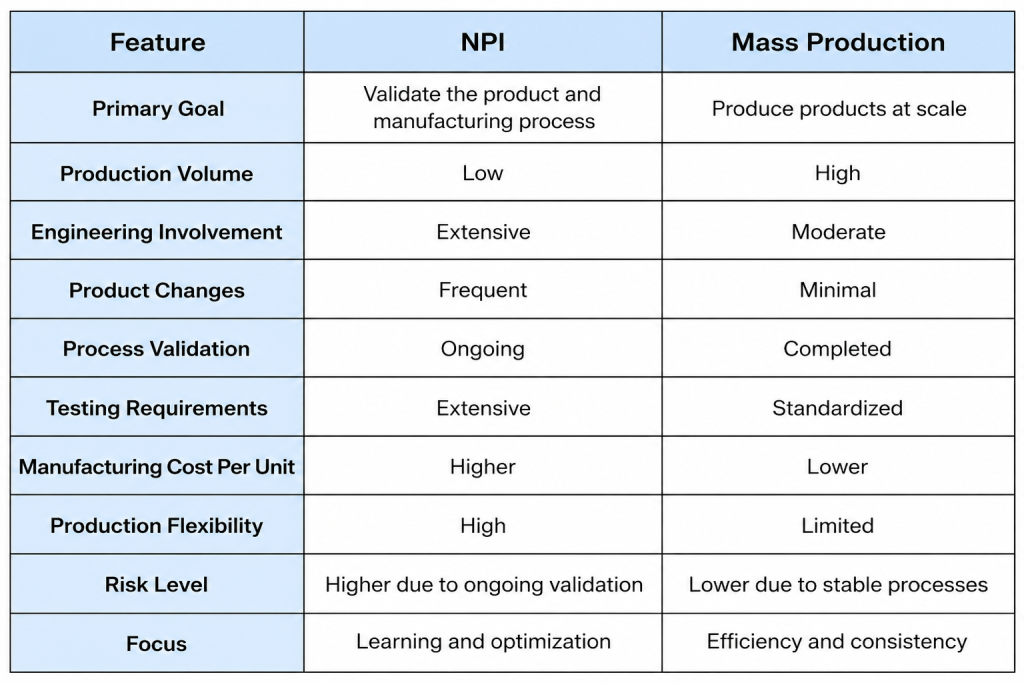
The biggest distinction is that NPI is designed to reduce uncertainty, while mass production is designed to maximize efficiency.
A successful NPI phase provides manufacturers with the confidence that every production variable from materials and assembly methods to testing procedures—has been validated before scaling.
Why the Transition Matters?
Many product launches experience delays not because the design is flawed, but because the transition between prototype and production isn’t carefully managed.
Industry studies continue to show that decisions made during product design have a significant impact on manufacturing costs. It’s widely estimated that 70–80% of a product’s total manufacturing cost is determined during the design and development stage, making early manufacturability reviews one of the most valuable investments manufacturers can make.
Additionally, modern electronics manufacturers increasingly rely on advanced inspection and adaptive testing technologies to improve quality while reducing unnecessary testing time, demonstrating how thorough validation during NPI contributes to more efficient production later.
By investing sufficient time in prototype validation, design optimization, and process refinement, companies can avoid costly rework, production delays, and quality issues once manufacturing volumes increase.
When Should You Transition from NPI to Mass Production?
Knowing when to move from NPI to full-scale production is one of the most important decisions in the product lifecycle. Transition too early, and you risk costly defects, production delays, and customer dissatisfaction. Wait too long, and you may miss market opportunities.
A product is generally ready for mass production when the following milestones have been achieved:
- The product design has been fully validated.
- All prototype testing has been successfully completed.
- The Bill of Materials (BOM) is stable.
- Manufacturing processes have been documented and validated.
- Key suppliers have been qualified.
- Pilot production demonstrates consistent quality.
- Functional and reliability testing consistently meets specifications.
- Manufacturing yields reach acceptable levels.
By this stage, the NPI manufacturing process has minimized uncertainty, allowing production teams to focus on efficiency rather than problem-solving.
Common Challenges When Moving to Mass Production:
Transitioning from prototype to production isn’t always straightforward. Even well-designed products can encounter manufacturing challenges if planning isn’t thorough.
Supply Chain Constraints:
A component that is readily available for a small prototype build may become difficult to source in larger quantities.
To reduce this risk:
- Qualify multiple suppliers.
- Monitor lead times.
- Review component lifecycle status.
- Validate substitute components early.
Manufacturing Yield Issues:
Processes that work well during Prototype PCB assembly may reveal hidden issues when thousands of boards move through automated production.
Examples include:
- Solder bridging
- Component misalignment
- Insufficient solder paste
- PCB warpage
- Reflow profile inconsistencies
Monitoring first-pass yield during pilot production helps identify these issues before they become expensive.
Quality Consistency:
As production volume increases, maintaining consistent quality becomes more challenging.
Successful manufacturers implement:
- Automated Optical Inspection (AOI)
- Functional testing
- Statistical Process Control (SPC)
- X-Ray inspection for complex assemblies
- Continuous process monitoring
Recent research on over 28,000 PCB assembly production runs demonstrated that adaptive testing strategies can significantly reduce test time while maintaining product quality, highlighting the growing role of intelligent quality systems in modern electronics manufacturing.
Engineering Changes:
Even after pilot production, improvements may still be required.
When this happens, manufacturers rely on an Engineering change order (ECO) to formally document design revisions, update production documentation, and communicate changes across engineering, procurement, and manufacturing teams.
A controlled ECO process helps prevent:
- Production errors
- Incorrect component installation
- Documentation mismatches
- Inventory waste
Production Bottlenecks:
Scaling production often exposes inefficiencies that weren’t visible during low-volume builds.
Common bottlenecks include:
- Manual assembly steps
- Slow inspection processes
- Equipment capacity limitations
- Material handling delays
- Workforce training gaps
Addressing these issues early enables a smoother production ramp-up.
How an EMS Partner Simplifies the Transition?
Moving from prototype to production requires more than manufacturing capacity it requires engineering expertise.
An experienced Electronics Manufacturing Services (EMS) provider helps bridge the gap between design and scalable manufacturing by supporting every stage of the electronics manufacturing process.
A reliable EMS partner can provide:
- Design for Manufacturability (DFM) reviews
- Component sourcing and procurement
- Prototype validation
- Pilot production
- Process optimization
- Automated inspection
- Functional testing
- Manufacturing documentation
- Quality assurance
- Production scaling support
Rather than simply assembling boards, the right partner becomes an extension of your engineering team, helping identify potential risks before they affect production.
Best Practices for a Successful Transition:
Companies that successfully scale production typically follow a structured approach.
Finalize the Product Design:
Avoid unnecessary revisions once production tooling and manufacturing documentation have been completed.
Complete Design for Manufacturability Reviews:
Small design improvements identified during DFM can significantly improve manufacturing efficiency while reducing production costs.
Validate Your Supply Chain:
Ensure suppliers can consistently meet quality, quantity, and delivery requirements before production begins.
Run Pilot Builds:
Pilot production helps validate:
- Manufacturing workflows
- Assembly quality
- Test procedures
- Equipment setup
- Production timing
Define Quality KPIs:
Track measurable performance indicators such as:
- First-pass yield
- Defect rate
- Cycle time
- Rework percentage
- Customer returns
These metrics provide early visibility into production performance and continuous improvement opportunities.
Mistakes to Avoid:
Many production delays stem from avoidable planning mistakes rather than technical failures.
Watch out for these common pitfalls:
- Scaling production before validating the design
- Ignoring DFM recommendations
- Poor supplier qualification
- Incomplete testing
- Weak documentation
- Poor communication between engineering and manufacturing teams
- Failing to manage an Engineering change order (ECO) effectively
- Skipping pilot production
Avoiding these mistakes helps reduce manufacturing risk while improving product quality and delivery performance.
How Cygnus Supports Every Stage of Product Manufacturing?
Whether you’re building your first prototype or preparing for full-scale production, choosing the right manufacturing partner makes all the difference.
At Cygnus Electronics, we support customers throughout the entire product lifecycle from Prototype PCB assembly and engineering validation to scalable Mass production electronics.
Our capabilities include:
- Prototype PCB Assembly
- PCB Assembly Services
- Design for Manufacturability (DFM)
- Component Procurement
- Functional Testing
- Automated Optical Inspection (AOI)
- X-Ray Inspection
- Box Build Assembly
- Turnkey Electronics Manufacturing Services
- Low-Volume and High-Volume Production
By combining engineering expertise with advanced manufacturing capabilities, Cygnus helps businesses reduce risk, improve quality, and accelerate time to market.
Conclusion:
The NPI manufacturing process provides the opportunity to validate designs, optimize workflows, and eliminate manufacturing risks before production volumes increase. Once those foundations are in place, Mass production electronics focuses on delivering consistent quality, lower unit costs, and predictable production performance.
A structured transition supported by thorough testing, supplier validation, and continuous process improvement lays the foundation for long-term manufacturing success.
If you’re preparing to move from prototype to production, partnering with an experienced EMS provider can make that transition smoother, faster, and more cost-effective.
Ready to scale with confidence? Contact Cygnus Electronics to learn how our engineering expertise and end-to-end manufacturing solutions can help bring your product from concept to full-scale production.
Frequently Asked Questions
What is the main difference between NPI and mass production?
The primary difference is purpose. The NPI manufacturing process focuses on validating product design and manufacturing readiness, while mass production focuses on efficiently producing large volumes with consistent quality.
How long does the NPI process usually take?
The timeline varies depending on product complexity, but most NPI projects take anywhere from several weeks to a few months. Factors such as design revisions, testing requirements, component availability, and supplier readiness all influence the schedule.
What happens if design changes are required after production begins?
Design updates are managed through an Engineering change order (ECO), which documents, reviews, and approves modifications before they are implemented. A structured ECO process minimizes production disruptions and maintains product quality.
Why is prototype PCB assembly important before mass production?
Prototype PCB assembly allows engineers to verify functionality, identify manufacturing challenges, validate components, and optimize production processes. Addressing these issues early reduces costly rework and improves the success of high-volume manufacturing.