
Hidden defects don’t just slow production they quietly destroy reliability, increase rework, and cost you real money.
That’s why choosing the right SMT inspection methods isn’t optional anymore, it’s critical.
If you’re deciding between AOI vs X-ray inspection in SMT, this guide will break it down clearly, practically, and from a real manufacturing perspective so you can make the right call.
What Is AOI and X-Ray Inspection in SMT?
AOI (Automated Optical Inspection) uses high-resolution cameras to visually inspect the PCB surface for defects like misalignment, missing components, or solder bridging.
X-ray inspection PCB systems, on the other hand, look inside the board detecting hidden defects in solder joints, especially in complex packages like BGAs.
In simple terms:
- AOI = What you can see
- X-ray = What you can’t see
Why PCB Inspection Matters in SMT Assembly?
Here’s the reality: most PCB failures don’t happen in design, they happen in manufacturing.
- Up to 70% of electronic failures are linked to solder joint issues
- Rework can increase production costs by 15–30%
- Field failures damage brand trust and increase warranty claims
A strong PCB quality inspection process ensures:
- Early defect detection
- Lower rework costs
- Higher product reliability
How AOI Inspection Works in SMT?
AOI inspection PCB systems operate as your first line of defense in the production line.
Step-by-Step AOI Process:
- High-speed cameras capture PCB images
- Software compares images with reference data (Gerber files)
- AI/algorithms detect inconsistencies
- Defects are flagged for review
What AOI Can Detect:
- Missing components
- Misaligned parts
- Polarity errors
- Solder bridges
- Excess or insufficient solder
AOI is fast, scalable, and ideal for high-volume production.
How X-Ray Inspection Works in PCB Assembly?
When defects hide beneath components, X-ray inspection PCB becomes essential.
How It Works:
- X-rays penetrate PCB layers
- Internal structures are visualized
- Software analyzes solder joints and connections
What X-Ray Inspection Detects:
- Voids in solder joints
- Cracks and internal fractures
- Hidden bridges
- Insufficient solder under components
This is especially critical for:
BGA inspection methods:
- QFN packages
- Multilayer boards
If your product uses advanced components, X-ray inspection solder joints is non-negotiable.
AOI vs X-Ray Inspection in SMT: Key Differences
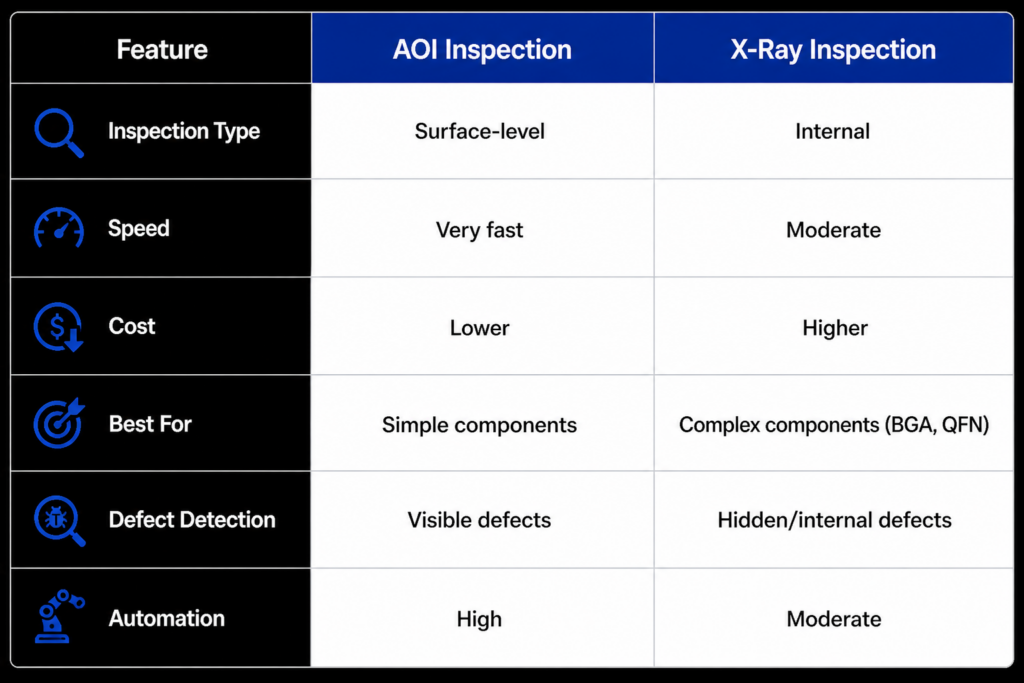
This comparison makes one thing clear: Both methods solve different problems.
Advantages of AOI in SMT Manufacturing:
Why do most manufacturers rely heavily on AOI?
- Fast inline inspection
- Cost-effective for mass production
- Detects common assembly defects
- Easy integration into production lines
For basic PCB inspection techniques, AOI is the backbone.
Advantages of X-Ray Inspection in PCB Assembly:
When precision matters, X-ray delivers.
- Detects hidden defects
- Essential for BGA inspection
- High accuracy in solder joint evaluation
- Reduces field failure risks
For critical applications, X-ray inspection PCB is a game-changer.
Limitations of AOI vs X-Ray Inspection:
AOI Limitations:
- Cannot detect hidden solder joints
- May produce false positives
- Limited for complex assemblies
X-Ray Limitations:
- Higher equipment cost
- Slower compared to AOI
- Requires skilled operators
Knowing limitations helps you build a smarter inspection strategy.
When Should You Use AOI vs X-Ray in SMT?
Here’s a practical breakdown:
- Use AOI when:
- High-volume production
- Standard components
- Need fast inspection
- Use X-ray when:
- Complex PCB designs
- BGA/QFN components
- High reliability required
Best practice? Use both together.
Also Read: How Surface Mount Technology Increases PCB Assembly Efficiency?
AOI + X-Ray: The Smart Inspection Strategy
Relying on one method alone leaves gaps.
Combining both ensures:
- Surface + internal inspection
- Reduced defect escape rate
- Improved product reliability
- Higher production yield
This is how modern manufacturers optimize their PCB quality inspection process.
Real Impact of Inspection Methods (Industry Stats)
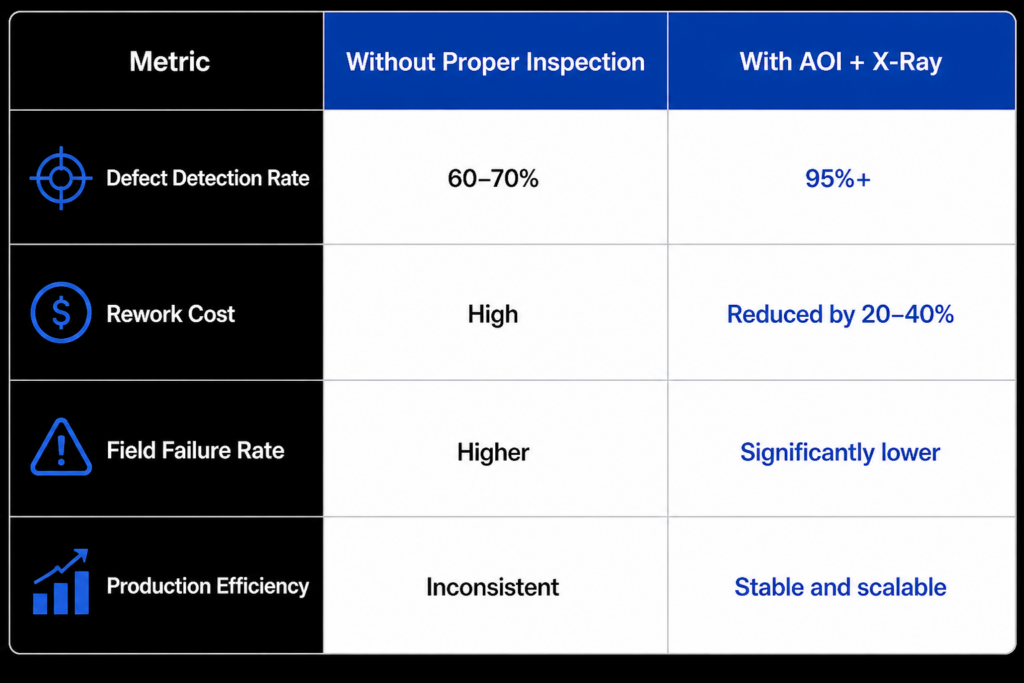
The takeaway: Better inspection = better margins + better products
How to Choose the Right PCB Inspection Technique
Before choosing between SMT inspection methods, consider:
- PCB complexity
- Component type (BGA, QFN, etc.)
- Production volume
- Budget
- Reliability requirements
There’s no one-size-fits-all only the right combination.
Build Reliable Electronics with the Right Inspection Partner
Choosing the right inspection method is important. But choosing the right manufacturing partner? That’s what truly defines your product quality.
At Cygnus Electronics, advanced PCB inspection techniques are built into every stage of production from AOI inspection PCB systems to high-precision X-ray inspection solder joints analysis.
If you want fewer defects, faster production, and reliable electronics:
Work with Cygnus and build it right the first time.
Final Takeaway:
If you’re still thinking about AOI vs X-ray inspection in SMT, you’re asking the wrong question.
The real answer is: Use both and build a complete inspection strategy.
Because in electronics manufacturing, what you don’t see…
is exactly what causes failures later.
FAQs
What is the difference between AOI and X-ray inspection in SMT?
AOI detects visible surface defects using cameras, while X-ray inspection identifies hidden defects inside solder joints and components.
Is AOI enough for PCB inspection?
AOI is effective for surface-level inspection but cannot detect internal defects. For complex PCBs, combining AOI with X-ray inspection is recommended.
Why is X-ray inspection important for BGA components?
BGA components have hidden solder joints that cannot be visually inspected. X-ray inspection ensures these joints are properly formed and reliable.
Which inspection method is more accurate?
X-ray inspection is more accurate for internal defects, while AOI is faster and efficient for surface-level inspection. Both are complementary.