The post What Does Flux Do in Soldering? (Complete Guide) appeared first on Cygnus.
]]>If you’ve ever wondered what does flux do in soldering, the answer is simple: it prepares the surface, improves solder flow, and ensures strong, long-lasting connections in PCB assembly.
What Does Flux Do in Soldering?
Flux in soldering is a chemical agent that prepares metal surfaces so solder can properly bond. Without it, solder simply won’t stick the way it should.
Here’s what flux actually does:
- Removes oxidation from metal surfaces
- Improves solder wetting (helps solder spread evenly)
- Prevents re-oxidation during heating
- Strengthens solder joints for long-term reliability
In short, the role of flux in soldering is to create the perfect conditions for a clean, strong, and conductive connection.
Why Flux Is Essential in Soldering?
Let’s make this practical.
Without flux:
- Solder beads up instead of flowing
- Joints become weak and unreliable
- Electrical connections fail over time
With proper flux in soldering:
- You get smooth, shiny joints
- Electrical conductivity improves
- Product reliability increases significantly
In modern electronics, especially what is flux in PCB assembly, this becomes even more critical. High-density boards and miniaturized components leave zero room for poor soldering.
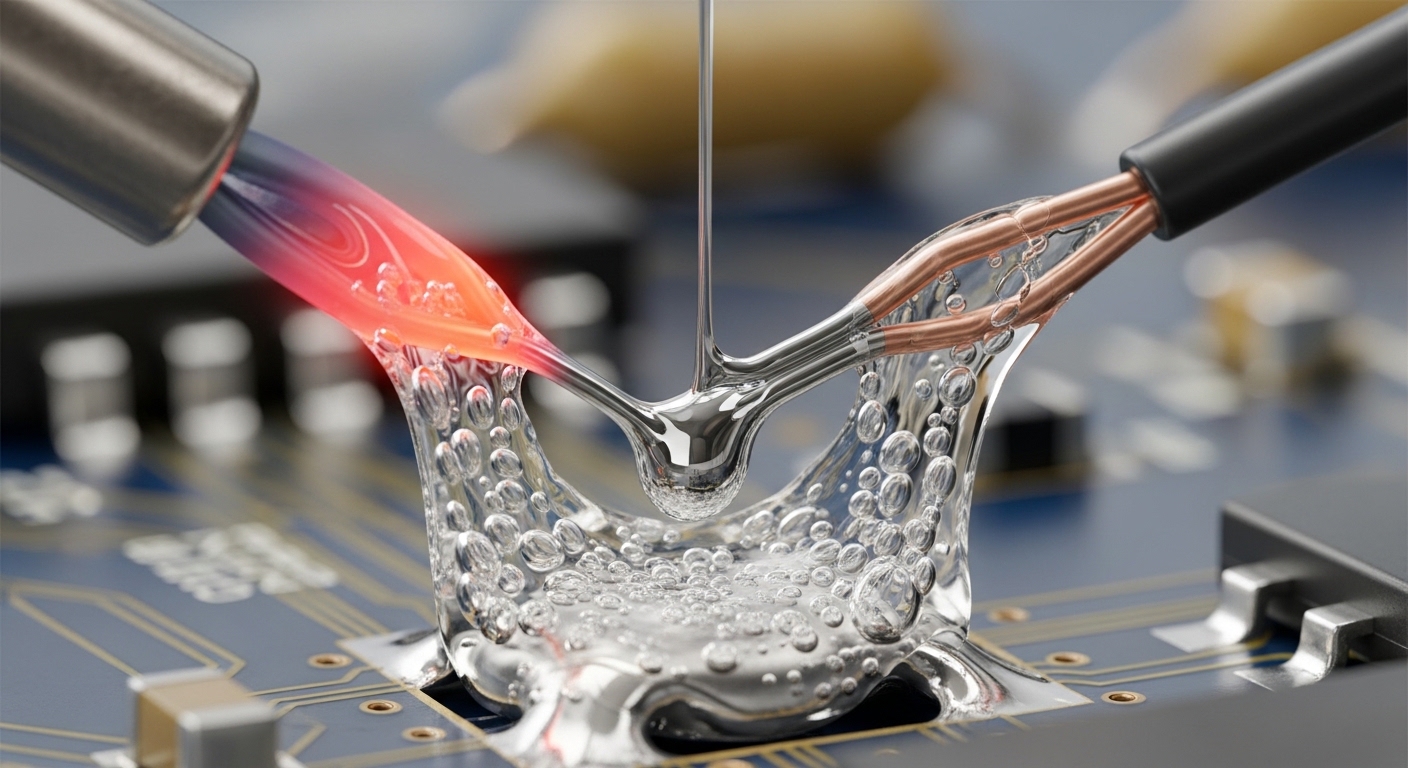
How Flux Works (Simple Breakdown)?
You don’t need a chemistry degree to understand this. Think of flux as a “surface cleaner + protector.”
Step 1 – Removing Oxides:
Metals naturally form oxidation layers when exposed to air. Flux breaks down these layers so solder can bond directly to clean metal.
Step 2 – Improving Wetting:
Flux allows molten solder to spread smoothly across pads and component leads instead of forming blobs.
Step 3 – Protecting the Surface:
During heating, flux creates a barrier that prevents oxygen from interfering with the soldering process.
That’s why understanding what does flux do in soldering is key—it’s not optional, it’s foundational.
Types of Flux Used in Soldering:
Different applications require different types of flux. Choosing the right one directly impacts quality.
Rosin Flux:
- Traditional and widely used
- Strong cleaning ability
- Requires cleaning after soldering
Water-Soluble Flux:
- Highly active and effective
- Ideal for complex assemblies
- Must be cleaned thoroughly
No-Clean Flux:
- Leaves minimal residue
- Common in modern PCB manufacturing
- Reduces post-processing steps
Each type plays a different role of flux in soldering, depending on the application and reliability requirements.
Flux in PCB Assembly vs Manual Soldering:
The role of flux changes depending on how soldering is performed.
In PCB Assembly (SMT & Automated Processes):
- Applied through controlled systems (spray, stencil, paste)
- Critical for consistent, repeatable results
- Used in reflow and wave soldering
In Manual Soldering:
- Applied directly via flux pens or core solder wire
- More dependent on operator skill
If you want to understand how flux behaves in automated environments, this detailed guide on reflow soldering processes explains how heat profiles and flux work together:
What Happens Without Proper Flux?
This is where problems begin.
Without proper flux in soldering, you’ll see:
- Cold solder joints
- Poor wetting
- Solder bridging
- Increased defect rates
These defects don’t just affect appearance they impact performance and reliability.
A deeper look at common manufacturing issues is covered here:
Effects of Too Much vs Too Little Flux:
Flux is powerful but only when used correctly.
Too Little Flux:
- Incomplete oxide removal
- Weak solder joints
- Poor wetting
Too Much Flux:
- Excess residue
- Potential contamination
- Cleaning challenges
This balance is critical in manufacturing environments.
If you want a deeper technical breakdown, this guide explains how incorrect flux volume directly impacts soldering quality
Flux Residue – Is It a Problem?
A common question in PCB manufacturing.
- No-clean flux leaves minimal residue, but not always zero risk
- Residue can affect high-reliability applications (medical, aerospace)
- Cleaning may still be required depending on standards
So while flux helps during soldering, managing its residue is equally important.
Why Flux Matters in Modern Electronics Manufacturing?
Today’s electronics are:
- Smaller
- Faster
- More complex
That means there’s no room for weak solder joints.
The role of flux in soldering becomes even more critical in:
- High-density PCB designs
- Lead-free soldering processes
- Advanced manufacturing environments
Flux directly impacts:
- Product lifespan
- Electrical performance
- Failure rates
In short, it’s a key factor in electronics manufacturing reliability.
How Cygnus Electronics Ensures Soldering Quality?
When it comes to consistent, high-quality PCB assembly, flux control isn’t guesswork it’s a science.
At Cygnus Electronics:
- Flux application is precisely controlled
- Advanced SMT and reflow processes ensure consistency
- Inspection methods like AOI and X-ray verify joint quality
- Every step is optimized for long-term reliability
If you’re developing electronic products and need dependable PCB assembly with strict process control, connect with Cygnus Electronics to ensure your products perform reliably from prototype to production.
FAQs
What does flux do in soldering?
Flux removes oxidation, improves solder flow, and helps create strong, reliable electrical connections.
Why is flux important in PCB assembly?
In PCB assembly, flux ensures proper bonding between components and pads, reducing defects and improving reliability.
Can soldering be done without flux?
Yes, but the results are usually poor weak joints, bad conductivity, and higher failure rates.
What happens if too much flux is used?
Excess flux can leave residue, cause contamination, and require additional cleaning processes.
The post What Does Flux Do in Soldering? (Complete Guide) appeared first on Cygnus.
]]>The post Why Local Manufacturing Partnerships Matter for Electronics Startups? appeared first on Cygnus.
]]>Many startups initially focus only on product design and overlook the importance of the manufacturing partner that will bring the product to life. Poor manufacturing decisions can lead to delays, inconsistent quality, rising costs, and frustrated customers.
That is why many successful hardware startups today prefer local manufacturing partnerships instead of relying entirely on overseas production. Working with a local electronics manufacturing partner provides better collaboration, faster production cycles, and stronger quality control.
Understanding why local manufacturing partnerships matter for electronics startups can help young companies move from prototype to successful product launch with far fewer risks.
What Are Local Manufacturing Partnerships?
A local manufacturing partnership refers to a collaboration between an electronics startup and a regional electronics manufacturing service (EMS) provider located within the same country or nearby region.
These manufacturing partners typically provide a wide range of services, including:
- PCB assembly
- product prototyping
- design for manufacturability (DFM)
- component sourcing
- product testing and validation
- small to medium production runs
Instead of sending designs overseas and waiting weeks for updates, startups can work directly with engineers and production specialists nearby. This closer collaboration makes the entire manufacturing process more efficient and transparent.
Also Read: The Role of SMT vs. THT in Modern Electronics Manufacturing
Why Manufacturing Partnerships Are Critical for Electronics Startups?
Electronics startups operate in fast-moving markets where speed and reliability are essential. A product that reaches the market quickly with consistent quality has a much higher chance of success.
Manufacturing partnerships play a crucial role in several areas, including:
- accelerating product development
- ensuring hardware reliability
- managing production scalability
- maintaining compliance with industry standards
- stabilizing the supply chain
Without the right manufacturing partner, startups often struggle to move beyond the prototype stage. Production delays, component sourcing issues, and quality problems can quickly derail even the most promising innovations.
Faster Prototyping and Product Development:
For electronics startups, speed of iteration is everything. The faster a team can test and refine prototypes, the faster it can launch a finished product.
Local manufacturing partnerships help startups accelerate development through:
- faster prototype builds
- direct engineering communication
- quick design adjustments
When manufacturers are located nearby, startups can work closely with production engineers to identify potential design improvements early. Instead of waiting weeks for overseas feedback, teams can test and revise their prototypes quickly.
This rapid iteration is especially important in industries such as:
- IoT devices
- consumer electronics
- industrial automation
- medical electronics
Faster development cycles allow startups to stay competitive and respond quickly to market opportunities.
Better Quality Control and Manufacturing Reliability:
Quality control is one of the biggest concerns in electronics manufacturing. Even small defects in assembly or components can cause product failures that damage a startup’s reputation.
Local manufacturing partnerships make it easier to maintain high quality standards because startups can:
- observe production processes
- conduct on-site inspections
- review testing procedures
- resolve issues quickly
Direct oversight significantly reduces the risk of defective units reaching the market.
For startups trying to establish credibility, consistent product quality is not optional—it is essential. A reliable manufacturing partner ensures that every unit meets the expected performance and safety standards.
Reduced Supply Chain Risks:
Global supply chains can be unpredictable. Over the past few years, many companies have experienced disruptions caused by shipping delays, component shortages, and geopolitical challenges.
Electronics startups that rely solely on overseas production often face issues such as:
- long shipping times
- customs delays
- fluctuating logistics costs
- communication barriers with suppliers
Local manufacturing partnerships reduce these risks by shortening supply chains and improving visibility into production.
With local partners, startups can manage inventory more efficiently, respond quickly to component shortages, and deliver products to customers faster.
Easier Communication and Engineering Collaboration:
Developing electronics products requires constant communication between designers, engineers, and manufacturing teams.
Local partnerships make this collaboration much easier.
Startups benefit from:
- real-time meetings with engineers
- faster technical feedback
- collaborative problem-solving
- improved design for manufacturability (DFM)
This direct interaction helps engineers refine designs so they are easier and more efficient to manufacture. As a result, startups avoid costly redesigns and production delays later in the process.
Good communication between engineering and manufacturing teams often leads to better products and smoother production cycles.
Protecting Intellectual Property and Product Designs:
Electronics startups invest significant resources in developing their technology. From hardware schematics to firmware architecture, intellectual property is often one of their most valuable assets.
Working with trusted local manufacturing partners can help protect these innovations.
Local partnerships provide advantages such as:
- stronger legal protections
- controlled production environments
- reduced risk of design replication
For startups introducing unique technologies or specialized hardware, protecting intellectual property is essential for maintaining a competitive advantage.
How Electronics Startups Should Choose the Right Manufacturing Partner?
Selecting the right manufacturing partner is a strategic decision that can shape the future of a startup. Companies should evaluate several important factors before committing to a partnership.
Technical Capabilities:
A manufacturing partner should have expertise in areas such as:
- PCB assembly
- electronics testing
- prototyping and small batch production
Industry Experience:
Manufacturers with experience supporting startups understand the challenges of transitioning from prototype to production.
Quality Assurance:
Strong quality control systems, certifications, and testing procedures ensure consistent product performance.
Scalability:
A good manufacturing partner should be able to support growth as production demand increases.
Choosing a partner that offers both engineering expertise and reliable manufacturing infrastructure can significantly improve a startup’s chances of success.
Why Local Electronics Manufacturing Is Becoming a Strategic Advantage?
Many technology companies are rethinking their manufacturing strategies and shifting toward regional production ecosystems.
This shift is driven by several factors:
- increased supply chain resilience
- faster innovation cycles
- stronger quality control
- reduced logistics complexity
Local manufacturing allows startups to respond quickly to design changes, market demands, and new opportunities.
In an industry where technology evolves rapidly, this flexibility can make a significant difference.
Partner with Experts Who Understand Electronics Manufacturing:
Bringing an electronics product to market requires more than a great idea. It requires the right manufacturing expertise, engineering support, and production reliability.
If your startup is looking for a trusted manufacturing partner, Cygnus Electronics provides comprehensive electronics manufacturing services designed to support innovation and growth.
From PCB assembly and prototyping to full-scale production, the team at Cygnus Electronics helps startups turn their hardware concepts into reliable, market-ready products.
Looking for a reliable manufacturing partner for your next electronics project?
Connect with Cygnus Electronics and build your product with confidence.
FAQs
Why are local manufacturing partnerships important for electronics startups?
Local manufacturing partnerships allow startups to collaborate closely with engineers, accelerate prototyping, improve quality control, and reduce supply chain risks. These advantages help startups bring products to market faster and more reliably.
Is local electronics manufacturing more expensive than overseas production?
While overseas manufacturing may appear cheaper initially, hidden costs such as shipping delays, quality issues, and communication challenges can increase overall expenses. Local manufacturing often provides better long-term value and reliability.
How do manufacturing partnerships help electronics startups scale?
Manufacturing partners provide technical expertise, production infrastructure, and quality control systems that allow startups to move from prototype development to scalable production more efficiently.
What should startups look for in an electronics manufacturing partner?
Startups should evaluate a manufacturer’s technical capabilities, quality assurance standards, prototyping services, industry experience, and ability to scale production when selecting a manufacturing partner.
The post Why Local Manufacturing Partnerships Matter for Electronics Startups? appeared first on Cygnus.
]]>The post Common User Experience Mistakes in Electronic Product Design (and How to Avoid Them) appeared first on Cygnus.
]]>They fail because users struggle to understand, operate, or trust them.
In today’s competitive market, user experience (UX) is no longer optional in electronic product design. A device that is powerful but frustrating to use quickly loses adoption, increases support costs, and damages brand reputation. This is why manufacturers and product teams are shifting toward user-centered electronic design from day one.
Let’s break down the most common user experience mistakes in electronic product design and how to avoid them before they become expensive manufacturing problems.
What Is User Experience (UX) in Electronic Product Design?
User experience in electronic product design refers to how easily, intuitively, and safely a user can interact with a device. It includes usability, control layout, feedback, ergonomics, accessibility, and how the product performs in real-world conditions.
In simple terms: If users struggle, the design has failed no matter how advanced the technology is.
The Most Common User Experience Mistakes in Electronic Product Design:
1. Designing for Engineers Instead of End Users:
One of the biggest UX mistakes in electronic product design is building products around technical logic rather than human behavior.
Engineers understand the system. Users don’t and shouldn’t have to.
Why this happens:
- Internal teams assume users think like designers
- Too much focus on features, not workflows
- Lack of early user research
How to avoid it:
- Define real user personas early
- Observe how users interact with similar devices
- Validate workflows through user testing before finalizing the design
At Cygnus Corp, usability reviews are integrated into the design phase to ensure products work for real users not just technical teams.
2. Poor Button Placement and Unintuitive Controls:
Bad control layout is one of the fastest ways to frustrate users.
Common problems include:
- Buttons placed where hands naturally don’t rest
- Controls that look similar but behave differently
- No logical flow between actions
Impact:
- User errors
- Safety risks in industrial or medical electronics
- Increased support calls and returns
How to avoid it:
- Apply ergonomic principles
- Test reach, grip, and hand movement
- Maintain consistency across controls and interfaces
Good electronic product design considers how people physically interact with devices not just how circuits connect.
3. Lack of Clear Feedback and Status Indicators:
Users need confirmation that their action worked.
When devices fail to provide feedback, users feel uncertain—and uncertainty leads to repeated inputs, errors, or device abandonment.
Examples of poor UX feedback:
- No LED, sound, or screen response after a button press
- Unclear error states
- Silent failures
How to avoid it:
- Use visual indicators (LEDs, icons, messages)
- Add audible or haptic feedback where appropriate
- Clearly distinguish between success, warning, and error states
Effective UX design in electronics reassures users at every interaction point.
4. Feature Overload That Confuses Users:
More features do not equal better user experience.
Many electronic products fail because they try to do too much at once—leading to cluttered interfaces and confusing menus.
Why feature overload hurts UX:
- Users struggle to find core functions
- Learning curves become too steep
- Products feel complex rather than powerful
How to avoid it:
- Prioritize core user tasks
- Use progressive disclosure (advanced features appear only when needed)
- Simplify menus and interactions
The best electronic products feel simple on the surface and powerful underneath.
5. Skipping Real-World Usability Testing:
Lab testing alone is not enough.
Electronic devices are used in unpredictable environments—factories, hospitals, outdoors, vehicles, or homes with distractions.
Common oversight:
- Testing only in ideal conditions
- Ignoring environmental factors like lighting, noise, gloves, or motion
How to avoid it:
- Test devices in real usage scenarios
- Include users with different skill levels
- Iterate designs based on real-world feedback
Cygnus Corp emphasizes prototyping and real-world testing to catch usability issues before mass production.
6. Ignoring Accessibility and Inclusive Design:
Accessibility is often treated as an afterthought—but it directly affects usability for everyone.
UX accessibility mistakes include:
- Small text and low-contrast displays
- Controls that require precision or strength
- Interfaces that assume perfect vision or dexterity
How to avoid it:
- Use readable typography and strong contrast
- Design controls that are easy to press and identify
- Consider diverse users, including elderly and non-technical users
Inclusive electronic product design improves usability, safety, and compliance—especially for medical and industrial devices.
How User-Centered Design Prevents UX Mistakes?
User-centered design prevents UX mistakes by involving real users throughout the product lifecycle from research and prototyping to testing and refinement ensuring electronic products are intuitive, reliable, and easy to use.
Also Read: Key Principles of User-Centered Design in Electronic Products
Key User-Centered Design Practices:
- Early user research and personas
- Rapid prototyping
- Iterative usability testing
- Design validation before manufacturing
This approach significantly reduces redesign costs and improves product success.
Why UX Mistakes Are Expensive in Electronics Manufacturing?
Poor UX decisions don’t just affect users they impact the entire manufacturing process.
UX mistakes lead to:
- Costly late-stage redesigns
- Delays in certification and compliance
- Higher warranty and return rates
- Long-term brand damage
Fixing usability issues after tooling or production has started is far more expensive than addressing them early.
How Cygnus Corp Helps Eliminate UX Mistakes in Electronic Products?
At Cygnus Corp, user experience is treated as a core engineering requirement—not a visual add-on.
Cygnus supports electronics companies with:
- User-focused electronic product design
- Design for manufacturability (DFM) with usability in mind
- Rapid prototyping and testing
- Scalable manufacturing-ready solutions
Whether you’re developing medical devices, industrial electronics, or smart products, Cygnus helps ensure your product works for users not against them.
Frequently Asked Questions (FAQs)
What is the most common UX mistake in electronic product design?
Designing for engineers instead of end users is the most common mistake, often resulting in complex and unintuitive products.
Why is usability testing important for electronic products?
Usability testing identifies real-world interaction issues early, preventing expensive redesigns and improving user satisfaction.
How does user experience affect product adoption?
Good UX increases trust, ease of use, and satisfaction—while poor UX leads to frustration, returns, and low adoption.
Can UX issues be fixed after manufacturing?
Some software-related issues can be fixed, but physical design flaws are costly to correct after production, making early UX planning critical.
The post Common User Experience Mistakes in Electronic Product Design (and How to Avoid Them) appeared first on Cygnus.
]]>The post SMT Reflow Soldering Process Explained: Step-by-Step Guide appeared first on Cygnus.
]]>This blog breaks down the reflow soldering step by step, explains why it’s essential, and walks you through everything you need to knowfrom key components to common defects and industry use.
What is Reflow Soldering in PCB?
Reflow soldering is a method used to attach electronic components to the surface of a PCB using solder paste and heat. The process gets its name from the way solder “reflows” melting and bonding to metal pads when exposed to heat.
What is reflow soldering in PCB manufacturing? It’s the preferred method for assembling surface-mounted devices (SMDs), especially for high-density boards where precision is critical.
Reflow Soldering vs. Wave Soldering
Wave soldering is more common in through-hole component assembly. In contrast, reflow soldering is more accurate and suitable for miniature components. It uses precise heating profiles and is ideal for double-sided boards, making it the go-to method in most SMT assembly lines.
Key Components Involved in Reflow Soldering
To carry out the SMT reflow soldering process, manufacturers use a few essential tools:
- PCB with Solder Paste: A thin stencil layer of solder paste is applied to the board.
- Pick-and-Place Machines: These machines place SMD components on the paste-covered pads with high speed and accuracy.
- Reflow Oven: Heats the board in controlled zones to melt and then cool the solder.
- Flux and Solder Paste: These aid bonding and remove oxidation from metal surfaces.
Reflow Soldering Step by Step:
Let’s walk through the reflow soldering step by step, breaking down each stage of the process:
1. Solder Paste Application:
A stainless-steel stencil is used to apply solder paste to the pads on the PCB. The accuracy of this step is vital—too much paste can cause bridging, while too little can cause weak joints.
2. Component Placement:
Next, high-speed pick-and-place machines carefully position SMDs on the solder paste. Orientation matters here, especially for polarized components like diodes and ICs.
3. Pre-Heating Stage:
The board enters the preheat zone of the reflow oven. During this phase, the temperature is gradually increased to prevent thermal shock. This is where flux begins to activate, helping remove oxides.
4. Soak Zone:
The board stays in this stage long enough for all areas to reach a uniform temperature. It also allows outgassing from the flux, preventing defects like solder voids.
5. Reflow Zone (Peak Temperature):
This is where solder melts, forming permanent joints. The reflow oven temperature profile must be carefully controlled here—too hot can damage components, too cold and the solder won’t flow properly.
- Most lead-free solders peak around 235°C–245°C, while leaded solder peaks around 215°C.
6. Cooling Zone:
Controlled cooling solidifies the joints and prevents stress cracks. Rapid cooling can lead to warping, so this stage is equally important.
Types of Reflow Ovens:
The reflow oven temperature profile and heat source depend on the type of oven used:
- Infrared (IR): Uses radiation but may heat unevenly due to varying absorption rates of components.
- Convection: Blows hot air for more even heating and is most common today.
- Vapor Phase: Uses condensation of a vaporized liquid to heat uniformly, ideal for sensitive assemblies.
- Nitrogen Reflow: Used in oxygen-sensitive environments to reduce oxidation and improve joint quality.
Each type influences how well the SMT reflow soldering process works, especially for complex boards.
Common Reflow Soldering Defects & Their Causes
Even the best-designed boards can suffer from common reflow soldering defects. Let’s look at the main ones:
- Tombstoning: One end of a component lifts, resembling a tombstone. Usually caused by uneven heating or paste volume.
- Cold Solder Joints: The solder doesn’t melt fully, leading to weak or unreliable connections.
- Solder Balling: Tiny balls of solder appear around joints—often due to too much paste or rapid heating.
- Voiding: Air pockets form inside joints, reducing conductivity and mechanical strength.
These common reflow soldering defects are detectable with Automated Optical Inspection (AOI) and X-ray inspection systems, and most can be prevented by fine-tuning the reflow oven temperature profile.
Best Practices for a Successful Reflow Process:
To avoid costly rework and ensure reliable products, follow these surface mount soldering techniques:
- Solder Paste Handling: Store paste in refrigerators, allow it to reach room temperature before use.
- Profile Optimization: Tailor your reflow oven temperature profile to suit the paste and components used.
- Routine Oven Maintenance: Clean and calibrate ovens regularly to avoid temperature deviations.
- Use AOI: Automated inspection catches misalignments, poor joints, and missing components early.
These best practices support a smooth and defect-free SMT reflow soldering process.
SMT Reflow Soldering in Industry Applications:
SMT and reflow soldering are essential in modern electronics:
- Consumer Electronics: Phones, TVs, laptops—everyday devices rely on SMT.
- Automotive: From sensors to infotainment systems, solder reliability is life-critical.
- Medical Devices: Requires high accuracy and zero-defect soldering for patient safety.
The ability to apply compact, high-speed, and reliable surface mount soldering techniques is a key driver behind the shrinking size and increasing complexity of electronics.
Conclusion:
The SMT reflow soldering process is the backbone of high-quality PCB assembly. From applying solder paste to carefully heating and cooling the board, each step must be executed with precision. Understanding the reflow soldering step by step and using the right surface mount soldering techniques can significantly reduce common reflow soldering defects and boost manufacturing efficiency.
By mastering the reflow oven temperature profile and avoiding typical mistakes, manufacturers can produce reliable, high-performance electronics across industries.
FAQs
What is reflow soldering in PCB, and why is it used?
Reflow soldering is a method of permanently attaching surface-mounted components to PCBs using solder paste and controlled heat. It’s used for its precision, reliability, and ability to handle complex assemblies.
How do I set the right reflow oven temperature profile?
Profiles typically include a preheat, soak, peak, and cooling phase. The exact temperatures depend on the solder type, but consistency and control are key.
What are some common reflow soldering defects to watch for?
Watch for tombstoning, cold joints, solder balling, and voids. Most defects are caused by uneven heating, poor paste application, or incorrect oven profiles.
How can I improve my surface mount soldering techniques?
Use high-quality solder paste, optimize pick-and-place precision, and ensure proper oven calibration. Regular inspection and testing are also essential.
The post SMT Reflow Soldering Process Explained: Step-by-Step Guide appeared first on Cygnus.
]]>The post Choosing the Right Power Line Filters for Industrial Applications appeared first on Cygnus.
]]>In this guide, you’ll learn what power line filters are, where they’re used, and—most importantly—how to apply a power line filter selection guide to ensure your systems run reliably and meet compliance standards.
What Are Power Line Filters and Why Are They Important?
A power line filter is an electrical component designed to block unwanted signals while allowing the desired power frequency to pass through. Think of it as a noise bouncer—it keeps interference out, so your systems can run smoothly.
These filters reduce electromagnetic interference (EMI) and radio frequency interference (RFI), which can otherwise wreak havoc on sensitive electronics. Industrial systems are especially vulnerable because they often run high currents, operate in harsh conditions, and integrate multiple machines that can generate interference.
If you’ve ever wondered, “Why do I need a power line filter?”, the answer is simple: to protect your equipment, comply with regulations, and achieve noise reduction in electrical systems.
Common Industrial Applications of Power Line Filters
Industrial power line filters aren’t just for one type of machine—they’re used across sectors:
- Manufacturing equipment: Protects robotic systems, CNC machines, and automated lines from EMI.
- Medical devices and lab equipment: Ensures accuracy in sensitive diagnostic tools.
- Renewable energy systems: Keeps solar inverters and wind energy systems efficient and compliant.
- Heavy-duty motors and drives: Reduces interference that could cause overheating or failure.
In short, wherever reliable performance matters, you’ll likely find a filter working quietly in the background.
Key Factors to Consider When Selecting a Power Line Filter
Not all filters are created equal. A proper power line filter selection guide should cover these essentials:
- Current and voltage rating – match the filter to your system’s load.
- Frequency range – ensure the filter suppresses EMI and RFI at the required levels.
- Compliance standards – look for certifications like CE, FCC, and UL to meet global requirements.
- Environmental conditions – consider heat, dust, vibration, and humidity that can affect performance.
Following these steps is crucial for choosing the right power line filter that fits your exact application.
Power Line Filters vs. Other EMI Solutions
It’s easy to confuse filters with other EMI solutions, but each serves a role:
- Chokes: Provide basic interference reduction but lack broad suppression.
- Ferrites: Good for quick fixes but less effective in high-power setups.
- Shielding: Blocks external noise but doesn’t address line-carried interference.
The advantage of industrial power line filters is that they directly address conducted EMI at the source, and can also be combined with other solutions for maximum protection.
Mistakes to Avoid When Choosing Power Line Filters
Even seasoned engineers can misstep during selection. Common mistakes include:
- Underrating current capacity – leading to overheating and premature failure.
- Ignoring environmental stress factors – dust, heat, and vibration can degrade performance fast.
- Overlooking compliance or testing – skipping this step risks costly non-compliance fines.
Avoiding these pitfalls ensures your investment delivers long-term noise reduction in electrical systems.
Case Study: How the Right Power Line Filter Improved System Reliability
Consider a manufacturing plant where frequent EMI issues caused downtime in automated assembly lines. After consulting a power line filter selection guide and upgrading to certified three-phase filters, the plant saw:
- A 40% reduction in downtime due to interference issues.
- Improved compliance with international EMI standards.
- Longer life expectancy for sensitive controllers and sensors.
This real-world example highlights the importance of choosing the right power line filter for your specific industrial environment.
Conclusion: Making the Right Choice for Industrial Success
Power line filters may be small components, but their impact is massive. By reducing interference, improving compliance, and boosting system reliability, they protect your investment in critical equipment.
The key takeaway? Don’t rush the process. Use a clear power line filter selection guide, factor in your environment, and focus on compliance. That way, you’ll not only achieve noise reduction in electrical systems but also set your business up for long-term success.
FAQs
How do power line filters reduce EMI in industrial applications?
They block unwanted high-frequency signals while allowing standard AC power to pass, keeping equipment stable.
What is the difference between single-phase and three-phase power line filters?
Single-phase filters are ideal for smaller devices, while three-phase filters handle heavy industrial machinery.
How do I know if my system needs a power line filter?
If you experience frequent EMI issues, compliance failures, or unstable operation, a filter is likely essential.
Can power line filters improve energy efficiency?
Yes—by reducing interference, they help equipment operate more reliably, which indirectly improves efficiency.
The post Choosing the Right Power Line Filters for Industrial Applications appeared first on Cygnus.
]]>The post How AI Is Transforming Quality Control on Modern Assembly Lines? appeared first on Cygnus.
]]>The Traditional Quality Control Process:
For much of manufacturing history, quality control on assembly lines has relied on manual inspections and random sampling. Trained inspectors examine parts or finished goods visually, using checklists and sometimes basic measurement tools. In some cases, simple sensors or vision systems flag obvious defects.
However, these approaches have their limitations:
- Human error: Even experienced inspectors can miss tiny flaws, especially during long shifts.
- Sampling limitations: Random sampling can overlook defects in unsampled items, leaving room for faulty products to reach customers.
- Slow feedback loops: When defects are found, it can take hours or days to trace the cause and make corrections, leading to wasted materials and time.
For manufacturers, these challenges translate into increased costs, customer complaints, and reputational risk.
Key Ways AI Is Revolutionizing Quality Control:
A. Computer Vision for Automated Defect Detection:
One of the most significant advances in assembly line automation is AI-powered defect detection using computer vision. High-resolution cameras scan every product as it moves down the line. Advanced AI algorithms process these images in real time, spotting even the tiniest defects—cracks, scratches, misalignments, and more—that the human eye could miss.
Example: In electronics manufacturing, AI-powered defect detection can identify micro-fractures on circuit boards or tiny misalignments in component placement, helping prevent product failures down the line.
Stat: According to Deloitte, AI-based visual inspection systems can increase defect detection rates by up to 90% compared to traditional manual methods.
Also Read: Role of Artificial Intelligence in Streamlining PCB Assembly Lines
B. Predictive Analytics for Preventive Action:
The use of AI in electronic manufacturing extends beyond spotting defects. Predictive analytics leverage AI to analyze production data from sensors, cameras, and equipment logs in real time. This allows the system to identify subtle patterns that often precede quality issues.
By flagging potential problems before they cause defects, manufacturers can make adjustments on the fly, reducing waste and minimizing rework. This proactive approach saves both time and money.
C. Machine Learning for Continuous Improvement:
Smart factories use a network of IoT sensors that monitor temperature, humidity, pressure, and other key metrics. When combined with AI, these sensors provide a continuous stream of data. The AI processes this data instantly, enabling quality control in smart factories that’s not just automated, but truly intelligent.
With immediate feedback and a closed-loop system, manufacturers can correct problems as soon as they arise—often before any defective product is made.
Real-World Examples and Case Studies:
Across various industries, the impact of AI for quality control is clear.
- Automotive sector: Ford and BMW have integrated AI-powered defect detection into their modern assembly lines, reducing defects by over 50% and saving millions in warranty costs.
- Electronics manufacturing: Global leaders like Foxconn use AI-driven visual inspection systems that process thousands of images per minute, ensuring high reliability in smartphones and other devices.
- Consumer goods: Procter & Gamble reported a 20% reduction in product recalls after implementing machine learning in manufacturing quality processes.
These results show just how effective AI-driven systems can be for improving quality and reducing costs.
Benefits of AI-Driven Quality Control:
Adopting AI on the modern assembly line brings several major benefits:
- Higher accuracy and consistency: AI systems never tire and can spot minuscule flaws with remarkable reliability.
- Faster response to defects: Issues are flagged instantly, not hours or days later.
- Reduced waste and downtime: Early detection means fewer scrapped materials and less rework.
- Enhanced traceability and compliance: Every inspection is logged, supporting regulatory compliance and product recalls.
A recent McKinsey study found that smart factories using AI and IoT for quality control can achieve up to 30% higher productivity and 20% lower quality-related costs.
Also Read: How Surface Mount Technology Increases PCB Assembly Efficiency?
Challenges and Considerations:
Of course, deploying AI for quality control isn’t without challenges:
- Implementation hurdles: Integrating AI with legacy equipment and ensuring high-quality training data can be difficult.
- Staff training: Workers need new skills, from operating AI-powered systems to interpreting data.
- Data privacy and security: With so much production data moving across connected devices, cybersecurity is essential.
- Cost of adoption vs. ROI: Initial investments can be significant, but most manufacturers see a strong return within 1-2 years.
Future Trends in AI Quality Control:
The landscape of assembly line automation is still evolving:
- Edge AI: Inspection and decision-making happening directly on the shop floor, even with limited internet connectivity.
- Real-time visual inspections: Instant analysis allows for even faster corrections and learning.
- Autonomous correction: In the future, AI systems may not only detect issues but also trigger robots or cobots to fix them without human intervention.
- Expanding reach: As solutions become more affordable, quality control in smart factories will become the norm, even for small and mid-sized manufacturers.
Conclusion:
The use of AI in electronic manufacturing and across other sectors is revolutionizing how we approach quality control. AI-powered systems make modern assembly lines faster, smarter, and more reliable. As technology matures, manufacturers who embrace these tools now will set the standard for quality, efficiency, and customer satisfaction in the years ahead.
Ready to future-proof your factory? Now’s the time to explore how AI can transform your quality control process.
Also Read: Integrating AI, IoT, and Cobots on the Assembly Line
Frequently Asked Questions (FAQs)
How does AI detect defects better than humans?
AI-powered defect detection uses computer vision and pattern recognition to analyze every product in real time. Unlike humans, AI can process thousands of images per minute and catch tiny flaws consistently, 24/7.
Can small and mid-sized manufacturers afford AI quality control solutions?
Yes. The cost of AI tools is dropping, and many cloud-based solutions offer scalable pricing. Most manufacturers see a strong ROI within 1-2 years thanks to reduced waste and fewer defects.
What skills do staff need to manage AI-based quality control?
Staff should be trained in basic data literacy and how to operate and maintain AI-driven systems. Upskilling workers for technical troubleshooting and data interpretation is increasingly important in smart factories.
How secure is production data when using AI and IoT systems?
Production data should always be encrypted, and manufacturers must follow best practices for cybersecurity. Regular audits, secure access controls, and real-time monitoring help protect sensitive data.
The post How AI Is Transforming Quality Control on Modern Assembly Lines? appeared first on Cygnus.
]]>The post PCB Assembly for Automotive Electronics – Challenges and Solutions appeared first on Cygnus.
]]>In this blog, we’ll explore the critical challenges in PCB assembly for automotive electronics and the solutions that help overcome them. Whether you’re an automotive engineer, a PCB manufacturer, or just curious about the technology inside modern vehicles, this blog post is for you!
Why PCBs Are Essential in Automotive Electronics
Before discussing the challenges and solutions, let’s understand the unique requirements of automotive PCB assembly. Unlike PCBs in consumer electronics, automotive PCBs must endure:
- Extreme temperatures (both high and low).
- Vibrations and shocks from the vehicle’s movement.
- Environmental conditions like humidity, dust, and chemicals.
- Stringent safety standards to ensure reliability in critical systems.
These demanding conditions make PCB assembly for automotive electronics a specialized field requiring precision, innovation, and adherence to strict regulations.
Key Challenges in PCB Assembly for Automotive Electronics
1. Harsh Operating Environments
Automotive PCB assembly must endure extreme temperatures, humidity, and vibrations. Just think about it, your car might be exposed to freezing cold or scorching heat, and every component inside must still perform perfectly.
- Temperature Extremes: From icy winters to hot summers, PCBs can face temperatures ranging from -40°C to 150°C.
- Vibrations and Shocks: Driving over rough terrain or hitting a pothole creates significant stress on electronic components.
- Moisture and Contaminants: Humidity, dust, and even oil can infiltrate and damage PCB assemblies.
2. Miniaturization of Components
As vehicles incorporate more features, space becomes a constraint. Automotive PCB design must cater to these demands by creating compact PCBs with multiple layers and densely packed components. This trend, while necessary for modern vehicles, increases the complexity of assembly and raises the risk of manufacturing defects.
3. High Reliability Standards
Failures in automotive electronics can have life-threatening consequences. This is why automotive PCB manufacturing is governed by strict quality and reliability standards enforced by regulatory bodies.
For instance, ISO 26262 focuses on functional safety and demands that every step, from PCB design to assembly and testing, is executed flawlessly. Meeting these stringent standards ensures that automotive PCBs are capable of supporting critical systems with the highest levels of safety and performance.
4. Electromagnetic Interference (EMI)
With so many electronic systems operating simultaneously, the risk of EMI rises. Poorly shielded or designed PCBs can cause signal disruptions, this impacts everything from infotainment to safety systems.
5. Complex Supply Chains
PCB Assembly for Automotive Electronics often require specialized components that aren’t always readily available. Supply chain disruptions, long lead times, or component shortages can delay production.
6. Cost Constraints
Car makers have limited budgets and need to manage the growing cost of modern electronics while keeping cars affordable for buyers. PCB manufacturers need to find smart ways to lower costs without reducing quality.
Solutions to Overcome Challenges in PCB Assembly
1. Robust Design for Harsh Environments
PCB Assembly for Automotive Electronics must be designed to withstand the challenging conditions of the automotive environment. Key strategies include:
- Material Selection: Use high-temperature-resistant laminates like FR-4 or polyimide for durability.
- Conformal Coatings: Protective coatings shield PCBs from moisture, dust, and contaminants.
- Shock Absorption: Employ reinforced soldering and flexible PCB designs to handle vibrations.
2. Using Modern Manufacturing Technologies
To make better and more reliable PCBs, manufacturers use modern technologies. These include:
- Surface Mount Technology (SMT): SMT allows precise placement of tiny components, reducing the risk of errors.
- Automated Optical Inspection (AOI): Machines inspect PCBs during and after assembly to detect defects early.
- X-Ray Inspection: This ensures that hidden solder joints and internal layers are defect-free.
3. Layered Testing for Reliability
Given the high stakes of failure, comprehensive testing is non-negotiable. Key tests include:
- Thermal Cycling Tests: Simulate temperature extremes to ensure PCB durability.
- Vibration Testing: Expose PCBs to simulated road conditions to test for resilience.
- EMI Shielding Tests: Confirm that PCBs won’t interfere with or be affected by other systems.
4. Designing for Electromagnetic Compatibility (EMC)
Mitigating EMI issues starts at the design stage:
- Ground Planes: Use well-designed ground planes to stabilize electrical signals.
- Shielding: Employ metal enclosures and shielded cables to protect sensitive circuits.
- Component Placement: Arrange components to minimize interference and signal degradation.
5. Efficient Supply Chain Management
PCB manufacturers can reduce delays and costs by:
- Vendor Partnerships: Collaborate with trusted suppliers for timely and reliable component sourcing.
- Component Standardization: Use commonly available components where possible to avoid shortages.
- Inventory Management: Adopt just-in-time (JIT) practices to balance stock levels and production needs.
6. Cost Optimization without Compromising Quality
Reducing costs requires strategic planning:
- Bulk Purchasing: Buy components in bulk to lower unit costs.
- Process Optimization: Streamline assembly processes to reduce waste and time.
- Smart Prototyping: Use virtual simulations to test PCB designs before committing to physical prototypes.
Also Read: The Benefits of Lean Manufacturing in EMS
Solutions Driving the Future of Automotive PCB Assembly
1. Advanced Automation
Automation in PCB assembly reduces human errors, enhances precision, and accelerates production timelines. Technologies like pick-and-place machines and reflow soldering ensure consistency in mass production.
2. Smart Manufacturing
Integration of IoT and AI in manufacturing processes allows for real-time monitoring and predictive maintenance, this minimizes downtime and improves quality control.
3. Flexible and Rigid-Flex PCBs
Flexible and rigid-flex PCBs are increasingly used to meet the demands of compact, lightweight designs without compromising durability.
4. Enhanced Testing Procedures
Modern testing methods, such as in-circuit testing (ICT) and functional testing, ensure that PCBs meet reliability standards before deployment.
5. Collaborative Partnerships
Working with trusted partners like Cygnus Electronics ensures access to the latest technologies, expert guidance, and end-to-end support throughout the automotive PCB manufacturing process.
Final Thoughts
PCB assembly for automotive electronics is no small feat. It requires a delicate balance of precision, innovation, and cost-efficiency. The harsh conditions of automotive environments and the high reliability demands make it one of the most challenging industries for PCB manufacturers. However, with strong designs, advanced manufacturing techniques, and efficient supply chain management, these challenges can be overcome.
Whether you’re a manufacturer, designer, or automotive enthusiast, understanding these challenges and solutions can inspire new ways to innovate and improve. After all, the road ahead is as exciting as it is challenging!
The post PCB Assembly for Automotive Electronics – Challenges and Solutions appeared first on Cygnus.
]]>The post 6 Mistakes to Avoid When Outsourcing Electronic Manufacturing appeared first on Cygnus.
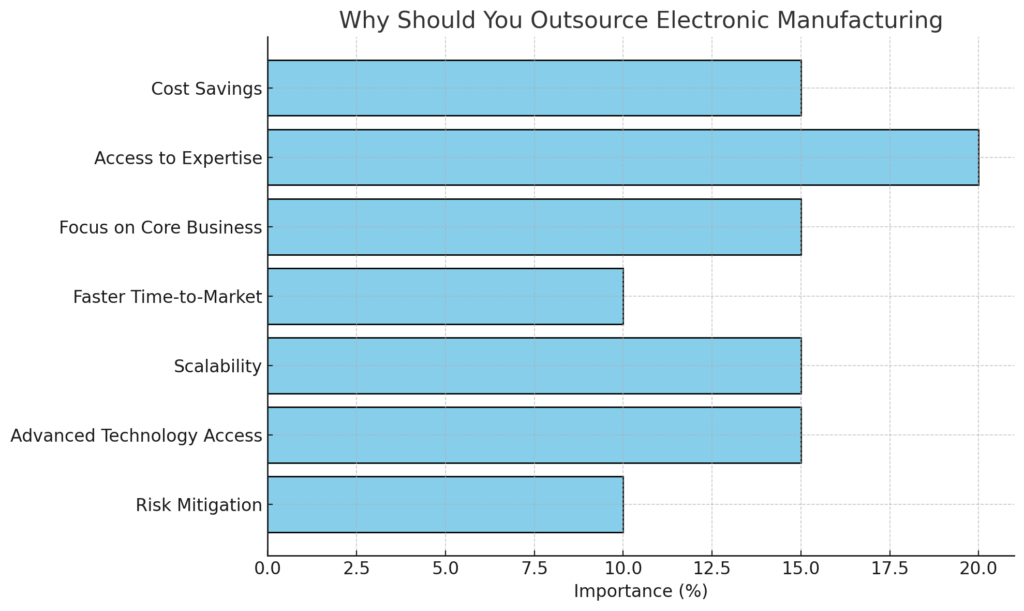
]]>
1. Failing to Define Clear Project Requirements
One of the biggest mistakes businesses make when outsourcing an assembly or other manufacturing tasks is failing to clearly outline their requirements. Without detailed project guidelines, manufacturers may produce components that fail to meet expectations.
Why It’s a Mistake?
- It increases the risk of miscommunication and errors.
- Leads to unnecessary delays and added costs.
How to Avoid?
- Draft a detailed project plan when creating a new project.
- Specify technical requirements, timelines, and quality expectations.
- Collaborate with your outsourcing partner to confirm that they fully understand the scope.
This step is essential to ensure that you avoid design and production errors that could affect the final product’s quality.
2. Selecting the Wrong Manufacturer
Choosing an inexperienced or unsuitable outsourcing partner is another common mistake. Not all manufacturers have the resources or expertise to handle specific projects, leading to subpar results.
Why It’s a Mistake?
- It could compromise product quality.
- You may encounter delays or budget overruns.
How to Avoid?
- Research potential manufacturers thoroughly.
- Look for certifications like ISO 9001 or industry-specific qualifications.
- Evaluate their past work and client testimonials.
However, remember, a good manufacturer will feel like an extension of your own team. For example, Cygnus Electronics specializes in electronic manufacturing services and offers expertise in design, development, and turnkey solutions tailored to your business needs. So, if you’re looking for a trusted partner, reach out to Cygnus for a consultation today!
3. Overlooking Communication Processes
Effective communication is vital when outsourcing tasks, especially in complex projects like electronics manufacturing. A lack of structured communication can lead to misunderstandings and prevent issues from being resolved promptly.
Moreover, open communication ensures you’re aligned with your manufacturer and reduces the risk of design and production errors.
Why It’s a Mistake?
- Updates may be missed, causing delays.
- Problems may escalate if not addressed early.
How to Avoid?
- Set up regular check-ins with your outsourcing partner.
- Use project management tools to track progress and address issues in real time.
- Ensure both teams have designated contacts for better coordination.
4. Ignoring Quality Control Measures
Many businesses assume that manufacturers will automatically uphold high-quality standards. However, neglecting quality checks throughout the process can result in defective products that are expensive to fix later.
Pro tip: Always include quality checks at every stage of the production process. Ask your manufacturer:
- Do they follow industry standards (like ISO certifications)?
- What are their testing capabilities?
- How do they handle defects?
Why It’s a Mistake?
- Quality issues can harm your brand reputation.
- Fixing defects post-production can delay project delivery.
How to Avoid?
- Implement a robust quality control system when outsourcing an assembly.
- Inspect samples and prototypes before full-scale production begins.
- Partner with a manufacturer with a proven track record of quality assurance.
5. Neglecting to Protect Your Designs and Ideas
Your intellectual property (IP) represents the heart of your innovation and creativity. It’s not just a collection of designs or concepts, it’s what differentiates your business in a competitive market. Neglecting to protect these valuable assets when outsourcing electronic manufacturing can result in devastating consequences, including unauthorized use, loss of competitive edge, and even theft.
When you share your designs and concepts with a third-party manufacturer, you’re essentially placing your trust in their ability to respect and safeguard your IP. Without proper measures in place, you risk losing control over your hard-earned ideas.
Why It’s a Mistake?
- Competitors could access your designs.
- It may affect your competitive edge in the market.
How to Avoid?
- Sign non-disclosure agreements (NDAs) with your outsourcing partner.
- Include IP protection clauses in your contracts.
- Collaborate with manufacturers in regions with strong IP laws.
Also Read: How to choose the best material for PCB
6. Focusing Solely on Cost
Any company choice is usually heavily influenced by cost, and outsourcing electrical production is no exception. But even while it would be tempting to go with the least expensive choice, doing so can result in long-term problems and more expenses later on.
You’re missing out on other important factors like quality, dependability, and the whole value a manufacturer can add to your project when you only consider pricing.
Why It’s a Mistake?
- Poor-quality components can harm your brand.
- You might face increased costs in the long run to correct errors.
How to Avoid?
- Evaluate the manufacturer’s reliability, quality standards, and scalability in addition to cost.
- Opt for a manufacturer offering a balance between affordability and high standards.
- Focus on long-term value instead of short-term savings.
Click here to find out how you can reduce PCB design cost
Final Thoughts
Outsourcing electronic manufacturing is a strategic decision that can deliver significant benefits, but it also comes with challenges. However, avoiding common pitfalls, like unclear requirements, poor communication, or ignoring quality control can make the process smoother and more efficient.
When you’re going to create a new project, it’s important to choose the right outsourcing partner like Cygnus Corp and ensure effective collaboration. This will help you avoid design and production errors while staying within budget and on schedule.
The post 6 Mistakes to Avoid When Outsourcing Electronic Manufacturing appeared first on Cygnus.
]]>The post The Benefits of Lean Manufacturing in EMS (Electronic Manufacturing Services) appeared first on Cygnus.
]]>Take out a moment and suppose you’re running an EMS business, handling complex orders, tight deadlines, and customers who expect nothing but the best. Every mistake, delay, or extra cost can hurt your business. Lean manufacturing helps you fix these issues by making your operations smooth, flexible, and focused on what matters most.
Either you’re making parts for the latest smartphones or electronics for electric vehicles, lean manufacturing helps you produce better quality products faster and at a lower cost. But what exactly is lean manufacturing? And how can it make a difference for EMS businesses like yours?
In this blog, we’ll explain how lean manufacturing works as well as discuss the benefits of lean manufacturing in EMS.
Also Read: Electronic manufacturing for small scale businesses.
What is Lean Manufacturing in EMS?
Lean manufacturing is a production methodology designed to eliminate waste, streamline workflows, and deliver high-quality products efficiently. In the EMS industry, the lean manufacturing process focuses on optimizing resources, improving quality, and meeting customer demands faster and more effectively.
The benefits of lean manufacturing in EMS are substantial. When EMS providers use lean manufacturing techniques, they can boost productivity, improve quality, and shorten lead times and ensure they remain competitive in a fast-evolving market. These techniques help businesses focus on continuous improvement, value addition, and waste reduction across all operations.
Click here to read out the smart strategies you can use to minimize manufacturing cost
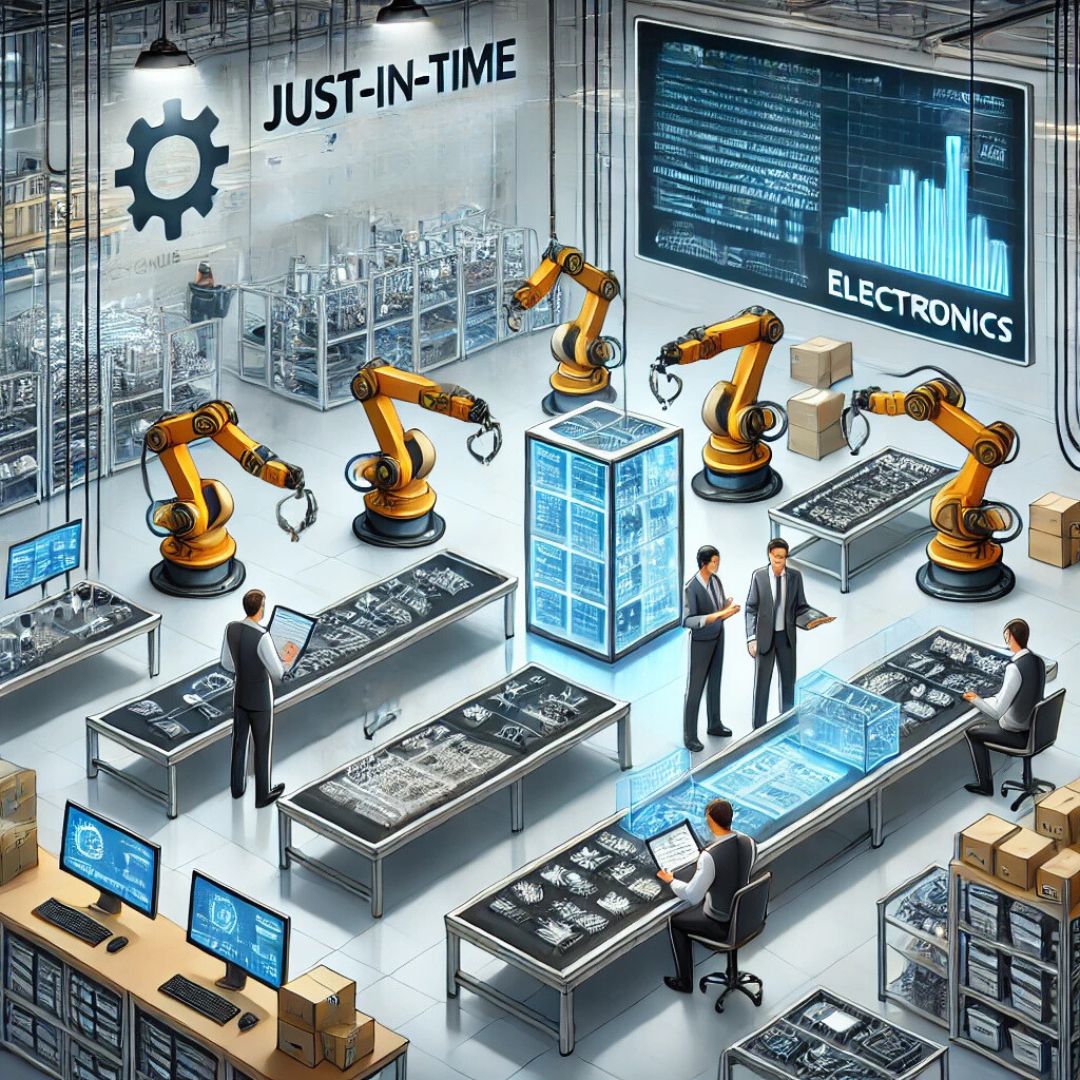
Benefits of Lean Manufacturing in EMS
1. Boosts Efficiency and Reduces Waste
The primary goal of lean manufacturing in EMS is to identify and eliminate waste whether it’s wasted materials, time, or labor. Manufacturers can streamline processes, reduce costs, and deliver products faster by focusing on efficient workflows. For example, lean practices like just-in-time (JIT) inventory management ensure materials are used when needed to avoid overproduction and storage costs.
2. Improves Quality Control
Quality is an important consideration in lean manufacturing strategies at all stages of production. EMS providers may reduce problems and maintain consistent product delivery by implementing strategies such as continuous monitoring and error proofing. This emphasis on quality not only increases consumer trust, but it also lowers the costs of rework and recall.
3. Enhances Productivity and Competitiveness
When companies implement the lean manufacturing process it helps them to optimize resources and focus on value-adding activities. With better workflows and reduced inefficiencies, EMS providers can increase output without increasing costs. As a result, they improve performance and competitiveness, standing out in a crowded market.
4. Shortens Lead Time
In the electronics sector, where consumer needs may change rapidly, speed is essential. However, lean manufacturing in EMS guarantees faster production cycles by removing bottlenecks and optimizing processes. In the end, this enables EMS providers to deliver goods to clients more quickly by achieving gains in productivity, quality, and lead time.
5. Eco-Friendly Practices
Waste reduction in lean manufacturing isn’t just about cutting costs, it also aligns with environmental sustainability. EMS companies practicing lean can reduce energy consumption, lower material waste, and contribute to greener manufacturing practices.
- Fact: Studies show that adopting lean methods can decrease industrial waste by up to 25%, a significant win for the environment.
6. Ecourages Employee Engagement
An effective lean daily management system guarantees that staff members actively participate in decision-making and problem-solving. In the end, this raises morale and productivity by fostering a sense of accountability and ownership. Workers are more driven to produce excellent work when they are aware of and supportive of the organization’s lean objectives.
Challenges in Adopting Lean Manufacturing in EMS
While the benefits are clear, adopting lean manufacturing in the EMS sector isn’t without its challenges.
1. Complex Supply Chains
EMS companies often work with global suppliers. Using lean manufacturing means carefully planning and coordinating to make sure parts arrive on time.
2. High Initial Investment
Transitioning to lean manufacturing may involve upfront costs for training, equipment upgrades, or system reorganization.
3. Cultural Shift
Lean manufacturing demands a culture of continuous improvement. Employees must be encouraged to identify inefficiencies and suggest improvements, a mindset shift for many traditional workplaces.
4. Demand Volatility
The electronics industry is highly unpredictable. Therefore, balancing lean inventory practices with fluctuating customer demands requires careful planning and agility.
5. Ongoing Commitment:
Lean manufacturing is not a one-time effort, it requires continuous monitoring and improvement.
How Cygnus Electronics Implements Lean Manufacturing
Lean manufacturing isn’t simply a catchphrase at Cygnus Electronics; it’s the foundation of everything we do. We use lean concepts to provide outstanding outcomes, from optimized design and development procedures to effective procurement and turnkey solutions.
Our dedication to reducing waste and increasing productivity guarantees that our customers will receive top-notch products on schedule and within their allocated budget.
Overcoming Barriers: Tips for EMS Companies
- Start Small
Focus on a single production line or process to implement lean principles and gradually expand to other areas. - Invest in Training
Teach your employees about the benefits and practices of lean manufacturing in EMS. When you provide the right knowledge and tools, it empowers your team to identify and fix inefficiencies. - Leverage Technology
Utilize advanced tools like automation, IoT, and AI to enhance lean practices and maintain precision in production. - Collaborate with Partners
Work closely with suppliers and customers to align on lean goals and ensure seamless integration of processes.
Conclusion
The benefits of lean manufacturing in EMS extend far beyond cost savings. By using lean manufacturing techniques, companies can improve how fast they work, the quality of their products, and the time it takes to deliver them, making sure customers get great value quickly.
Moreover, the lean manufacturing process fosters innovation, sustainability, and employee engagement, all of which contribute to long-term success.
For EMS providers looking to improve performance and competitiveness, lean manufacturing offers a proven path forward. With its focus on continuous improvement and waste reduction, lean practices ensure that businesses stay agile, efficient, and ready to meet the demands of the future.
The post The Benefits of Lean Manufacturing in EMS (Electronic Manufacturing Services) appeared first on Cygnus.
]]>The post IoT in Electronic Manufacturing – Benefits, Applications, and Challenges. appeared first on Cygnus.
]]>One industry where IoT is causing a stir is electronic manufacturing. These days, it goes beyond simply making circuit boards and devices. IoT enables firms to create better goods, work more efficiently, and save money. IoT is transforming conventional factories into high-tech centers, from devices that can “talk” to one another to systems that anticipate potential problems.
But why is this important, and what does it actually mean for manufacturers? We’ll explain everything in straightforward language, so don’t worry. We’ll look at how IoT functions in electronic manufacturing in this article, as well as the fascinating advantages it offers and how it’s influencing the sector’s future. You’re at the proper place whether you’re unfamiliar with the idea or want to learn more about it! Let’s begin, then.
What is IoT in Manufacturing, and How Does It Work?
IoT refers to a network of interconnected devices that communicate with each other using sensors, software, and the internet. In the context of electronic manufacturing, IoT enables machines, tools, and systems to share data in real time and provide valuable insights for decision-making.
For example:
- A production machine equipped with IoT sensors can monitor its performance and send alerts if maintenance is needed.
- Smart assembly lines can adjust operations dynamically to meet production demands or detect defects.
These connected systems create a smart factory environment. Moreover, they optimize efficiency and ensure quality.
How IoT for Electronics Enhances the Intelligence of Your Devices?
IoT for electronics connects your devices to the internet, and allows them to collect data, communicate with each other, and make decisions on their own. This means that devices like smartphones, wearables, and home appliances can “think” and respond based on real-time information.
For example, a smart thermostat can learn your preferences and adjust temperatures automatically, or a smart fridge can track its contents and notify you when you’re low on groceries. So, by using sensors, software, and connectivity, IoT makes everyday devices more intuitive, efficient, and responsive to your needs.
Benefits of IoT in Electronic Manufacturing
Let’s take a closer look at the ways IoT enhances electronic manufacturing:
1. Predictive Maintenance
Traditional maintenance schedules can be costly and inefficient. IoT-enabled devices use real-time data to predict when a machine might fail or require servicing. This minimizes unexpected downtime and reduces repair costs.
For instance:
- IoT sensors monitor vibration, temperature, or energy consumption in machines, predicting potential issues before they occur.
2. Improved Quality Control
IoT in manufacturing helps maintain high-quality standards by identifying defects during production. With real-time monitoring, IoT systems can detect issues as soon as they arise.
This not only reduces waste but also ensures that products meet the required quality standards. By catching problems early, manufacturers can enhance product reliability and minimize the chances of defects reaching the consumer.
For example:
- Smart cameras combined with IoT can inspect circuit boards for minute defects, to ensure each component meets quality standards.
3. Enhanced Supply Chain Management
With IoT, manufacturers can track raw materials, components, and finished products throughout the supply chain. This visibility ensures efficient inventory management and reduces delays.
Case in point:
- RFID tags and IoT devices can monitor shipments in transit and provide live updates on their location and condition.
4. Energy Efficiency
IoT technology helps manufacturers reduce energy consumption by monitoring and optimizing energy use across facilities. Through smart sensors and real-time data collection, IoT in electronic manufacturing allows businesses to identify energy inefficiencies and make adjustments automatically. This not only leads to significant cost savings but also helps companies meet their sustainability goals.
Examples include:
- Smart meters tracking energy usage in production lines.
- IoT-powered lighting systems that adjust based on occupancy.
5. Real-Time Analytics for Better Decision-Making
IoT collects massive amounts of data, which manufacturers can analyze to make informed decisions. From improving workflows to forecasting demand, IoT-driven analytics create opportunities for continuous improvement.
For instance:
- A factory manager can use IoT dashboards to track production metrics and identify bottlenecks instantly.
Challenges in Implementing IoT in Manufacturing
High Initial Investment
Implementing IoT technology in electronic manufacturing can be expensive due to the cost of hardware, software, and the necessary infrastructure for integration. But cost can be minimized by following such strategies. Click to read more. While the long-term benefits outweigh the initial expense, companies must carefully plan their budgets to cover setup and installation costs.
Data Security Concern
As IoT devices collect and transmit large amounts of sensitive data, so it becomes a top priority to ensure the security of this information. Manufacturers must address potential vulnerabilities in their networks to prevent cyber threats and ensure that critical data remains safe from unauthorized access.
Complexities in Integrating
Integrating IoT technology into existing manufacturing processes and systems requires thorough planning and expertise. The complexity of linking new IoT devices with old machinery, software, and operational workflows can present challenges that need to be carefully managed to avoid disruptions.
Skill Gap
With the introduction of IoT, manufacturers may face a skill gap in their workforce. Employees will need training to use, manage, and maintain new IoT systems effectively.
Therefore, upskilling the workforce to handle these advanced technologies is crucial for ensuring smooth operations and maximizing the potential of IoT in electronic manufacturing.
Also Read: Explore the Common Challenges Faced with AOI Systems
Key IoT Applications in Electronic Manufacturing
1. Smart Assembly Lines
IoT systems enable assembly lines to adapt dynamically in order to ensure smooth operations. Machines communicate with each other, adjust speed or settings, and detect errors in real time.
2. Remote Monitoring and Control
IoT allows manufacturers to monitor equipment remotely and offers flexibility and efficiency. So, technicians can troubleshoot issues without being physically present.
3. Digital Twins
Digital twins are virtual replicas of physical systems or products. Using IoT data, manufacturers can simulate and test operations or designs before implementing changes in the real world.
4. Inventory Management
IoT streamlines inventory tracking by integrating sensors and automated systems. This prevents overstocking or shortages.
5. Worker Safety
IoT enhances workplace safety by monitoring environmental conditions and providing alerts in case of hazards.
Also Read: How Automation Helps in Optimizing Electronic Manufacturing Processes?
The Future of IoT in Electronic Manufacturing
The future of IoT in electronic manufacturing industry looks bright, thanks to improvements in technologies like artificial intelligence (AI), machine learning (ML), and faster 5G internet. These advances will make IoT systems smarter, quicker, and more efficient, and also open up new possibilities for manufacturers.
For instance:
- AI-powered IoT devices will predict trends and optimize operations without human intervention.
- 5G networks will enable near-instant communication between devices, further enhancing real-time capabilities.
Final Thoughts
It is impossible to overestimate the importance of IoT in electronic manufacturing. IoT is changing every facet of the industrial process, from smart supply chains to predictive maintenance. IoT-enabled manufacturers will be better able to overcome obstacles, innovate, and prosper as the technology advances.
Although implementing IoT may seem like a big step, the benefits greatly exceed the costs. You open the door to a more intelligent, effective, and sustainable future by bringing IoT into your industrial procedures.
The post IoT in Electronic Manufacturing – Benefits, Applications, and Challenges. appeared first on Cygnus.
]]>