







Electronic devices rely on thousands of connections working flawlessly together. While advanced components often receive the most attention, the humble solder joint is what keeps everything connected.
A single failed solder joint can cause intermittent signals, system malfunctions, overheating, or complete product failure. In industries such as automotive, aerospace, telecommunications, and industrial automation, even a minor connection issue can lead to costly downtime and warranty claims.
Understanding the top reasons for solder joint failure helps manufacturers improve reliability, reduce defects, and ensure long-term product performance.
What Is a Solder Joint and Why Does It Matter?
A solder joint is the electrical and mechanical connection created when solder bonds a component lead to a printed circuit board (PCB). These joints allow electrical current to flow between components while also securing them physically to the board.
When properly formed, solder joints provide:
- Reliable electrical conductivity
- Mechanical stability
- Resistance to vibration and thermal stress
- Long-term product reliability
However, when solder joints are poorly formed or exposed to excessive stress, solder joint failure can occur, affecting the performance of the entire system.
Also Read: Impact of Incorrect Flux Volume on Soldering Quality and Reliability
Why Solder Joint Failure Is a Major Concern in Electronics Manufacturing?
The reliability of a PCB often depends on the quality of its solder joints. Industry studies have shown that interconnection failures remain one of the leading causes of electronic assembly failures.
Poor solder joints can result in:
- Product recalls
- Increased warranty costs
- Rework and repair expenses
- Production delays
- Customer dissatisfaction
According to manufacturing quality studies, the cost of correcting defects after product shipment can be several times higher than identifying and fixing them during production.
This is why manufacturers invest heavily in PCB assembly quality control, inspection processes, and testing procedures.
Also Read: Role of Flux in Preventing Reflow Soldering Defects
Top Reasons for Solder Joint Failure:
The most common causes of solder joint failure can help manufacturers prevent reliability issues before products reach the field.
1. Cold Solder Joints:
A cold solder joint occurs when solder does not melt or flow properly during assembly.
Common causes include:
- Insufficient soldering temperature
- Improper heating duration
- Poor wetting of surfaces
- Contaminated components
Cold joints often appear dull, rough, or grainy instead of smooth and shiny.
Impact
- Weak electrical connections
- Intermittent operation
- Increased resistance
- Early product failure
2. Thermal Cycling and Temperature Stress:
Electronic devices frequently experience temperature changes during operation.
As components heat and cool, materials expand and contract at different rates. Over time, this repeated movement can create microscopic cracks within solder joints.
Industries most affected include:
- Automotive electronics
- Aerospace systems
- Industrial control equipment
- Outdoor communication devices
Thermal cycling is one of the most significant causes of solder joint failure in long-life electronic products.
3. Poor PCB Design and Component Layout:
Even the best manufacturing process cannot fully compensate for poor design.
Design issues that contribute to solder joint defects include:
- Improper pad sizing
- Uneven copper distribution
- Inadequate thermal relief
- Poor component spacing
Design-for-Manufacturing (DFM) reviews help identify these issues before production begins.
Also Read: Common Reflow Soldering Defects and How to Prevent Them?
4. Mechanical Stress and Vibration:
Products exposed to constant movement face additional reliability challenges.
Examples include:
- Automotive control systems
- Industrial machinery
- Transportation electronics
- Aerospace applications
Continuous vibration can weaken solder joints and eventually cause cracking or separation.
The larger and heavier the component, the greater the stress placed on the solder connection.
5. Insufficient or Excess Solder:
The amount of solder used directly affects joint integrity.
Insufficient Solder:
Can lead to:
- Weak bonding
- Open circuits
- Reduced mechanical strength
Excess Solder:
Can result in:
- Solder bridges
- Electrical shorts
- Inspection failures
These issues are among the most common soldering defects found during PCB assembly.
6. Flux Residue and Contamination:
Clean surfaces are critical for creating reliable solder joints.
Contamination may come from:
- Dust
- Oils
- Moisture
- Fingerprints
- Residual flux
Contaminants interfere with solder wetting and can eventually cause corrosion.
Over time, contamination-related issues may develop into serious solder joint failure problems.
7. Voids and Air Pockets:
Voids are trapped air pockets inside a solder joint.
These hidden defects reduce:
- Mechanical strength
- Electrical performance
- Heat dissipation capability
Voids are particularly problematic in:
- Power electronics
- LED assemblies
- High-current applications
Because they are often invisible from the surface, X-Ray inspection is commonly used to detect them.
8. Lead-Free Solder Challenges:
Environmental regulations have increased the adoption of lead-free solder.
While beneficial for compliance, lead-free alloys present unique challenges:
- Higher processing temperatures
- Increased brittleness
- Greater sensitivity to thermal stress
Manufacturers must carefully optimize soldering processes to maintain reliability.
Common Signs of Solder Joint Failure:
Recognizing failure symptoms early can prevent more extensive damage.
| Symptom | Possible Cause |
| Intermittent operation | Cracked solder joint |
| Random shutdowns | Thermal fatigue |
| Signal loss | Cold solder joint |
| Overheating | Poor connection or voids |
| No power | Open solder joint |
| Visible cracks | Mechanical stress |
Identifying these warning signs quickly can reduce repair costs and improve product reliability.
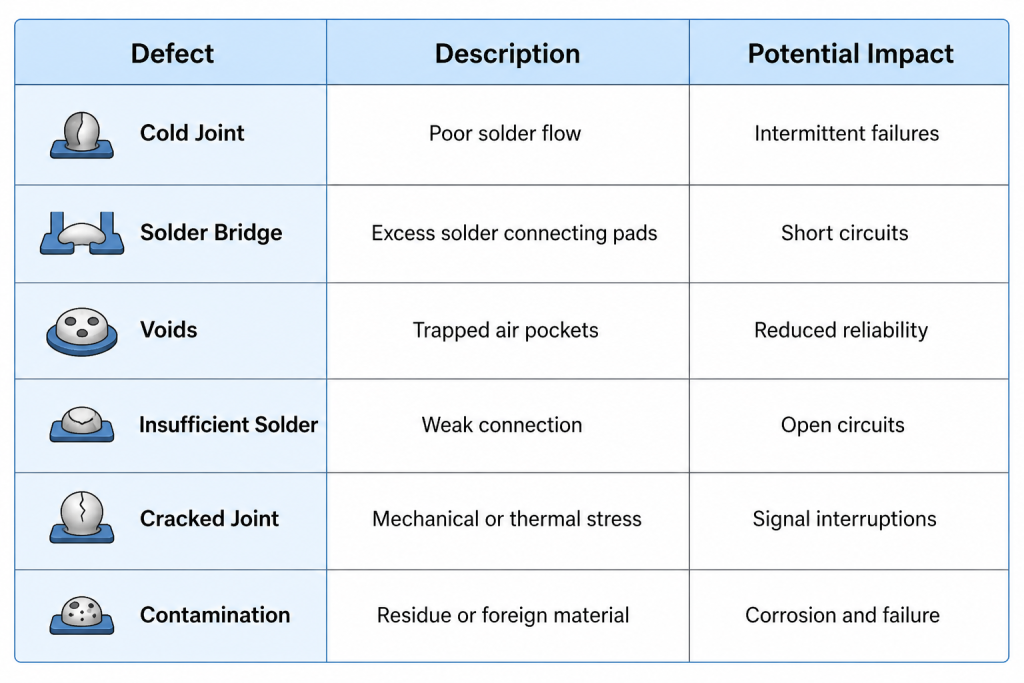
Common Soldering Defects and Their Impact:
The following table summarizes some of the most frequently observed common soldering defects in electronics manufacturing.
How Electronics Manufacturers Prevent Solder Joint Failures?
Preventing defects requires a combination of process control, inspection, and industry best practices.
Process Optimization:
Manufacturers monitor:
- Reflow temperature profiles
- Solder paste quality
- Placement accuracy
- Process consistency
These controls significantly reduce solder joint defects before they occur.
Advanced Inspection:
Quality-focused manufacturers use:
- Automated Optical Inspection (AOI)
- X-Ray Inspection
- Visual Inspection
- Functional Testing
These tools identify defects early in the manufacturing process.
Compliance with IPC Soldering Standards:
Following IPC soldering standards ensures solder joints meet recognized industry requirements for workmanship and reliability.
IPC guidelines provide manufacturers with clear acceptance criteria for:
- Joint appearance
- Solder coverage
- Defect classification
- Inspection requirements
Compliance with IPC soldering standards helps improve consistency across production runs.
The Role of PCB Assembly Quality Control:
Strong PCB assembly quality control programs are essential for preventing defects and maintaining product reliability.
Effective quality control includes:
- Incoming material inspection
- Process monitoring
- AOI verification
- X-Ray analysis
- Functional testing
- Root cause analysis
When combined, these processes dramatically reduce manufacturing defects and improve product performance.
Simply put, quality is not inspected into a product it is built into the process.
Why Choosing the Right EMS Partner Matters?
Reliable solder joints don’t happen by chance.
They result from:
- Experienced engineering teams
- Controlled manufacturing processes
- Advanced inspection technologies
- Continuous quality improvement
An experienced Electronics Manufacturing Services (EMS) provider understands how to identify potential risks before they become costly failures.
By prioritizing PCB assembly quality control, adhering to IPC soldering standards, and utilizing advanced testing methods, manufacturers can significantly improve product reliability and reduce field failures.
Conclusion:
Solder joints may be small, but their impact on product performance is enormous.
The top reasons for solder joint failure include cold solder joints, thermal cycling, contamination, mechanical stress, insufficient solder, voids, and poor design practices. Fortunately, most of these issues are preventable through proper engineering, process control, inspection, and testing.
At Cygnus Electronics, we help OEMs and manufacturers improve product reliability through precision PCB assembly, advanced inspection technologies, rigorous testing, and industry-leading quality assurance practices. Whether you’re building prototypes or scaling production, our team is committed to delivering electronic assemblies that perform reliably in the real world.
Contact Cygnus Electronics today to discuss your next manufacturing project.