






Modern electronics are getting smaller, faster, and more complex. But behind every reliable PCB assembly is one small chemical component that quietly plays a massive role: flux.
Without the right flux, solder joints can fail, components may not bond properly, and long-term PCB reliability can suffer. From consumer electronics to aerospace systems, choosing the correct flux directly impacts manufacturing quality and product performance.
In this guide, we’ll break down the main types of flux in PCB assembly, compare no-clean flux vs water-soluble flux, explain the role of rosin flux in PCB assembly, and help manufacturers understand which option works best for different applications.
What Is Flux in PCB Assembly?
Flux is a chemical cleaning agent used during soldering to remove oxidation, improve solder flow, and help create strong electrical connections between components and the PCB.
During soldering, metal surfaces naturally develop oxidation when exposed to air. This oxidation prevents solder from bonding correctly. Flux removes these contaminants and improves solder adhesion.
The main functions of flux include:
- Removing oxides from metal surfaces
- Improving solder wetting
- Preventing re-oxidation during heating
- Enhancing solder joint reliability
- Reducing soldering defects
In simple terms, flux helps solder “stick” properly.
Without proper flux, manufacturers may experience:
- Cold solder joints
- Poor conductivity
- Solder bridging
- Weak mechanical bonds
- Corrosion-related failures
This is why selecting the right PCB soldering flux types is critical in electronics manufacturing.
Why Flux Matters More in Modern PCB Assembly?
Today’s PCBs are far more advanced than older electronic boards. Manufacturers now deal with:
- Miniaturized SMT components
- Fine-pitch packages
- High-density PCB layouts
- Lead-free soldering temperatures
- Faster automated production lines
These factors make flux performance even more important.
According to IPC industry studies, soldering defects account for a significant percentage of PCB manufacturing failures, with poor wetting and contamination among the leading causes in assembly defects.
As PCB complexity increases, manufacturers need better:
- Solder wetting improvement
- Residue control
- Thermal stability
- Cleaning compatibility
- Reliability under harsh conditions
This is where understanding the differences between flux types becomes essential.
Main Types of Flux in PCB Assembly
There are three major types of flux in PCB assembly commonly used in electronics manufacturing:
- No-Clean Flux
- Water-Soluble Flux
- Rosin Flux
Each type offers different advantages depending on the application, cleaning requirements, reliability standards, and production environment.
No-Clean Flux Explained
What Is No-Clean Flux?
No-clean flux is designed to leave minimal residue after soldering, reducing or eliminating the need for post-solder cleaning.
It is one of the most widely used PCB soldering flux types in high-volume electronics manufacturing because it simplifies production and lowers operational costs.
Advantages of No-Clean Flux:
Faster Manufacturing:
Since cleaning is often unnecessary, production moves faster.
Lower Operational Costs:
Manufacturers save on:
- Cleaning chemicals
- Water usage
- Cleaning equipment
- Labor costs
Better for High-Volume SMT Assembly:
No-clean flux works especially well in automated SMT production environments.
Environmentally Friendlier:
Reduced chemical cleaning means lower environmental impact.
Challenges of No-Clean Flux:
While efficient, no-clean flux does have limitations.
Flux Residue in PCB Assembly:
Even minimal residue can sometimes:
- Affect conformal coating adhesion
- Complicate inspection
- Cause reliability concerns in sensitive applications
Difficult Rework
Residue may become difficult to remove during PCB repairs.
Not Ideal for Harsh Environments
Industries like aerospace and medical electronics may require cleaner assemblies with stricter reliability standards.
Water-Soluble Flux Explained:
What Is Water-Soluble Flux?
Water-soluble flux contains organic compounds designed for aggressive oxide removal and excellent solderability.
Unlike no-clean flux, it requires a full PCB cleaning process after soldering.
Advantages of Water-Soluble Flux:
Excellent Solder Wetting Improvement:
Water-soluble flux provides outstanding solder flow and bonding performance.
This makes it ideal for:
- Complex SMT assemblies
- Fine-pitch components
- High-density PCBs
Better Oxide Removal:
It performs well on heavily oxidized surfaces.
Superior Reliability:
When cleaned correctly, it leaves very little contamination behind.
Challenges of Water-Soluble Flux:
Mandatory Cleaning Process:
Improper cleaning can leave ionic contamination behind, increasing corrosion risks.
Higher Manufacturing Costs:
Manufacturers must invest in:
- Cleaning systems
- DI water systems
- Drying equipment
- Process monitoring
Moisture Sensitivity:
Residual contamination can absorb moisture and impact PCB reliability.
Rosin Flux in PCB Assembly:
What Is Rosin Flux?
Rosin flux in PCB assembly is made from natural pine resin and has been used in electronics manufacturing for decades.
It remains popular in specialized applications because of its strong oxidation protection and reliable soldering performance.
Types of Rosin Flux:
R (Rosin):
Mild activation level with low cleaning power.
RMA (Rosin Mildly Activated):
Balanced cleaning ability and residue characteristics.
RA (Rosin Activated):
Highly aggressive cleaning action for difficult surfaces.
Advantages of Rosin Flux:
Reliable Soldering Performance:
Rosin flux performs consistently across many soldering applications.
Good Oxidation Protection
It helps protect metal surfaces during soldering.
Proven Industry History
Many military and industrial applications still use rosin-based formulations.
Challenges of Rosin Flux
Residue Removal
Rosin residue often requires solvent cleaning.
Smoke and Fumes
Rosin fumes may require proper ventilation systems.
Environmental Concerns
Traditional solvent cleaning methods may not align with modern environmental standards.
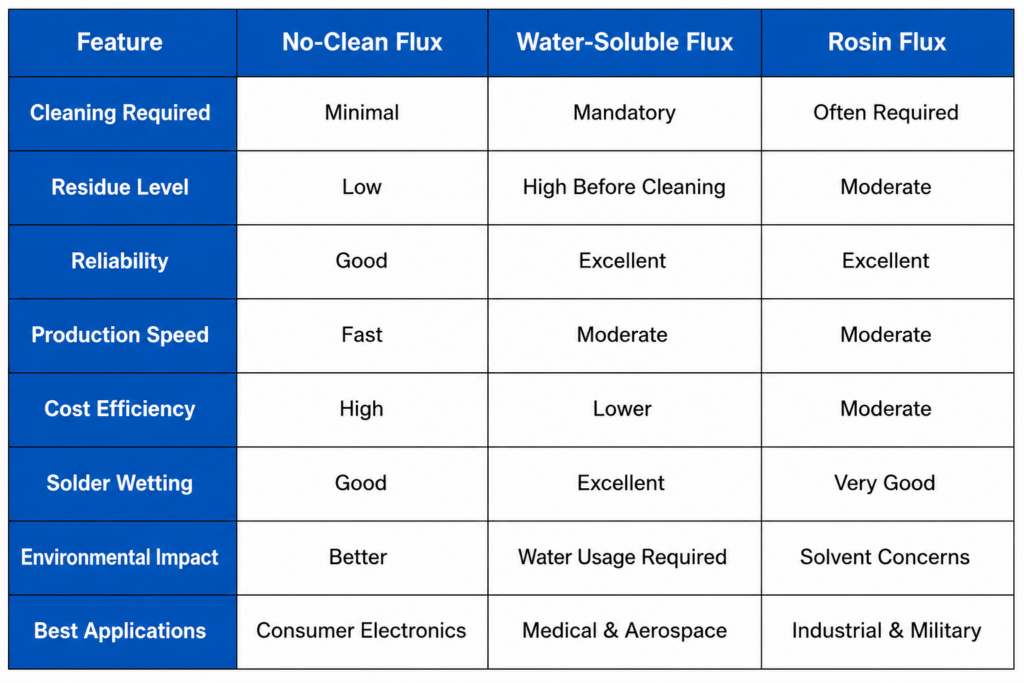
No-Clean Flux vs Water-Soluble Flux vs Rosin Flux
Here’s a practical comparison of the most common PCB soldering flux types:
Lead-Free Soldering Flux Challenges:
The transition toward lead-free soldering flux systems has introduced new manufacturing challenges.
Lead-free solder alloys melt at higher temperatures compared to traditional tin-lead solder. This increases:
- Thermal stress
- Oxidation risk
- Flux activation demands
As a result, manufacturers now require fluxes with:
- Better thermal stability
- Stronger oxide removal
- Improved residue control
According to electronics manufacturing industry reports, lead-free soldering can increase soldering temperatures by 30–40°C compared to traditional processes.
This makes flux chemistry more important than ever.
The Importance of Flux Residue Control:
One of the biggest concerns in modern assembly is flux residue in PCB assembly.
Improper residue management can cause:
- Corrosion
- Dendritic growth
- Electrical leakage
- Signal interference
- Reduced product lifespan
This is especially critical in:
- Medical devices
- Automotive electronics
- Aerospace systems
- High-frequency PCBs
Manufacturers often perform:
- Ionic contamination testing
- Visual inspection
- SIR testing (Surface Insulation Resistance)
- Cleanliness verification
to ensure long-term PCB reliability.
How to Choose the Right Flux?
There is no universal “best” flux.
The right choice depends on:
- PCB complexity
- Reliability requirements
- Production volume
- Cleaning capabilities
- Environmental conditions
- Industry standards
Choose No-Clean Flux If:
- You need faster production
- Cost efficiency matters
- Minimal cleaning is preferred
Choose Water-Soluble Flux If:
- Reliability is critical
- You can support full cleaning systems
- Your application requires ultra-clean assemblies
Choose Rosin Flux If:
- You need strong oxidation protection
- You work in specialized industrial applications
- Traditional processes are preferred
Flux Selection Trends in Electronics Manufacturing:
Modern PCB manufacturing is shifting toward:
- Low-residue formulations
- Eco-friendly chemistries
- Better lead-free compatibility
- Automated flux control systems
Manufacturers are increasingly focusing on:
- Process consistency
- Lower defect rates
- Sustainability
- High-reliability assembly standards
This evolution continues to drive innovation in lead-free soldering flux technologies and automated cleaning systems.
Final Thoughts:
Choosing between no-clean flux vs water-soluble flux or deciding whether rosin flux in PCB assembly is suitable for your application can significantly impact manufacturing quality, production efficiency, and long-term reliability.
The best flux is not simply the cheapest or fastest option. It’s the one that aligns with your:
- PCB design
- Reliability goals
- Production process
- Industry requirements
As electronics continue becoming more advanced, flux chemistry remains one of the most important foundations of reliable PCB assembly.
Need Reliable PCB Assembly Support?
Cygnus Electronics provides professional PCB assembly and electronics manufacturing solutions with a strong focus on quality, process control, SMT/THT assembly, inspection, and reliable production practices. Whether you need prototype builds or scalable manufacturing support, their team helps ensure dependable electronics manufacturing outcomes.